Beyond Heat Removal: How -180°C Nitrogen Unlocks a Physics Leap for AI Data Centers
When the data center industry discusses cooling 100 kW+ racks and dense GPU clusters, the conversation almost always revolves around conventional heat rejection: chilling water, evaporative towers, and managing thermal dissipation.
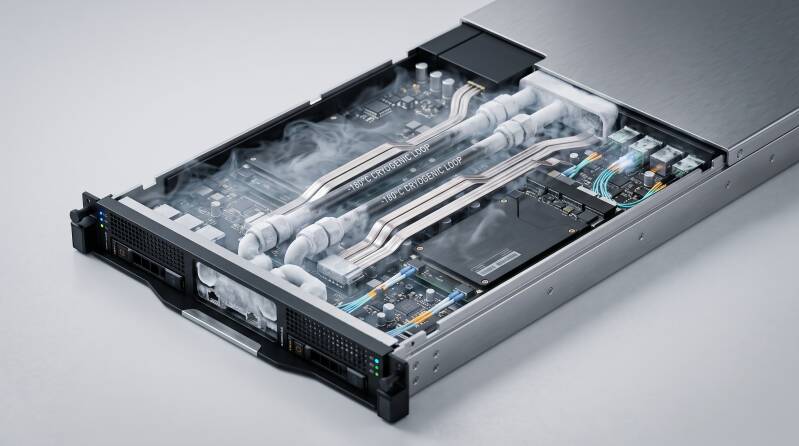
Delivering cryogenic nitrogen at -180°C does not just replace chillers; it fundamentally changes solid-state semiconductor physics and electrical architecture.
1. The Solid-State Performance Boost (Cryo-CMOS)
At -180°C (approx. 93 K), silicon semiconductors operate in an entirely different physical regime:
* Electron Mobility: Lattice vibrations (phonons) drop exponentially, allowing electrons to move through transistor channels with minimal scattering.
* Zero Subthreshold Leakage: Static power leakage—which accounts for a massive portion of idle GPU power draw at standard temperatures—drops toward zero.
* Massive Sustained Clocks: Processors run substantially higher operational frequencies without hitting thermal throttling boundaries. A single cryo-conditioned rack can match the effective compute throughput of several ambient-cooled clusters.
2. Zero-Loss Power Distribution (HTS Superconductivity)
High-Density AI facilities are bottlenecked by the physical thickness and ohmic heat dissipation of 48V/12V copper busbars.
* High-Temperature Superconductors (HTS), such as YBCO tapes, become fully superconducting well above -180°C.
* Power distribution across the white space achieves zero electrical resistance (I²R = 0), eliminating voltage drop, reducing cable volume, and eliminating copper resistive heat within the server envelope.
3. Advanced Cooling: Direct Phase-Change & Micro-Flash Evaporation
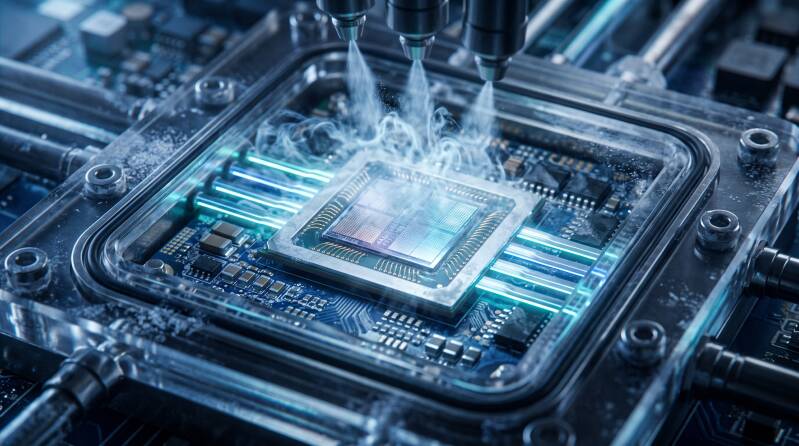
Instead of pumping heavy liquids through microchannels, -180°C nitrogen enables targeted micro-flash spray on heat spreaders:
* Extreme Heat-Flux Absorption: Exploiting latent heat of vaporization (h_fg) allows immediate mitigation of extreme hotspot fluxes (>1,200 W/cm²).
* Dynamic Self-Pumping: Phase change creates localized expansion that purges vapor without requiring heavy mechanical liquid pumps inside the rack.
4. Intrinsic Fire Suppression & Zero-Humidity Integrity
* Passive Halon-Free Fire Suppression: An inert nitrogen-rich enclosure physically prevents ignition and electrical arcing without requiring chemical fire-suppression tanks.
* Zero Corrosion & Moisture: Dry nitrogen permanently purges ambient humidity, completely eliminating tin whiskers, condensation risks, and connector pin oxidation.
The transition to sub-zero nitrogen moves cooling from a parasitic balance-of-plant tax into a fundamental driver of compute density and electrical efficiency.
#DataCenterDesign #CryoCMOS #Superconductivity #AIHardware #ThermalManagement #CleanCompute #PUE #EnergyTransition