The "Coal Case" with HPDD:
1. How It Is Done Today: The "Brute Force" Way
Before a power plant or factory can burn coal, the solid chunks must be ground into a powder.
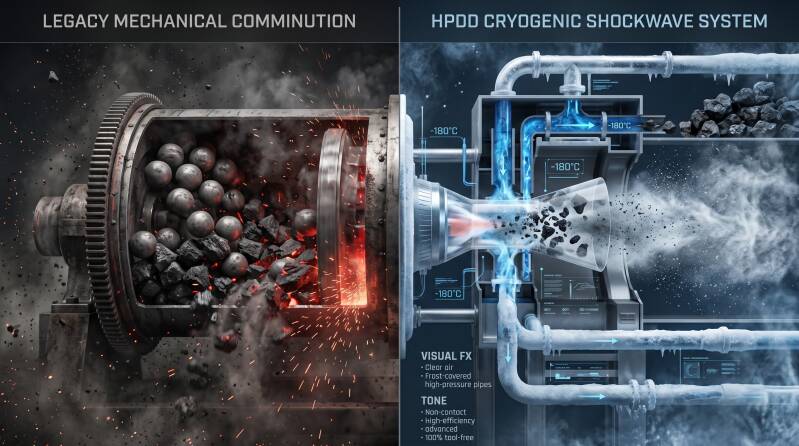
* Heavy steel balls: Massive lumps of rock are dumped into huge spinning drums filled with heavy steel balls to crush the coal with raw force.
* Massive power loss: Up to 3% to 5% of all the electricity the plant produces is burned just keeping these giant mills turning.
* Non-stop wear and tear: The metal parts grind against rock, wearing down rapidly and requiring constant, costly maintenance.
2. The HPDD Approach: Breaking with Cold and Air Pressure
Instead of mechanically squashing the coal, the HPDD system applies fundamental physics:
* Freezing it like glass (Cryogenic effect):
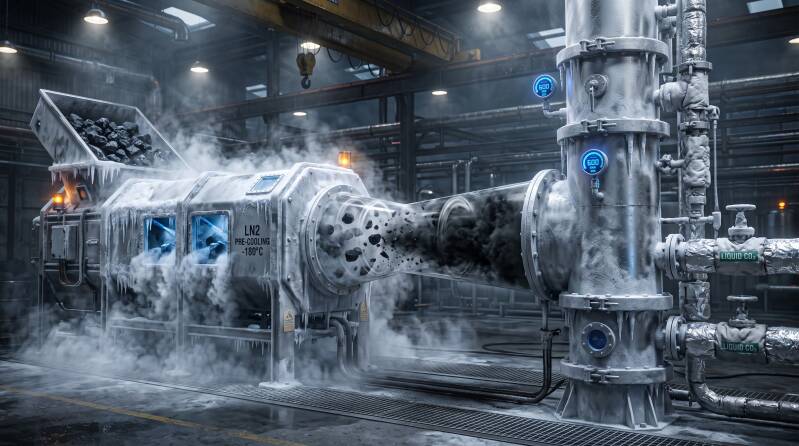
* Just like a rubber band or a flower turns brittle when dropped into liquid nitrogen, the ice-cold nitrogen stream (down to -180°C) from the HPDD process is directed over the coal.
* The coal instantly loses its toughness and becomes as fragile as glass.
* A blast of air pressure (Shockwaves):
* The brittle coal is sent through a rapid pressure drop.
* An aerodynamic shockwave shatters the rock mid-air along its natural fault lines into an ultra-fine, uniform dust (down to 1 micron).
* Zero metal wear:
* No spinning drums, heavy rollers, or metal grinding balls are used, eliminating mechanical wear parts.
3. What This Delivers:
* Cleaner, complete combustion: Because every particle is microscopic and uniform in size, the powder burns instantly and thoroughly, reducing unburned ash and cutting harmful emissions like NO_x.
* Major power savings: The plant eliminates the heavy motor drives of the mills, freeing up millions of kilowatt-hours for productive output.
* Ready-to-store CO_2: Because the HPDD cycle operates natively under high pressure (up to 600 bar), the resulting CO_2 condenses straight into a dense liquid without needing separate, energy-draining compressor units.
In short: instead of grinding coal with heavy mechanical crushers, HPDD freezes it brittle and shatters it mid-air with shockwaves, slashing electricity waste, eliminating equipment wear, and capturing the emissions cleanly.