

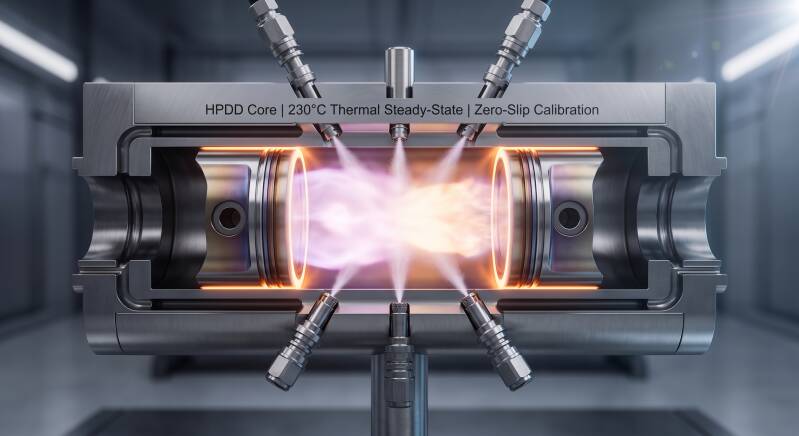
Mastering Ammonia: Combustion Kinetics, Flame Speed & Zero-Slip Control
Burning green ammonia in a marine powerplant is not the hard part. The real engineering discipline lies in mastering its combustion kinetics without severe unburned slip or atmospheric greenhouse penalties.
Ammonia is a challenging zero-carbon fuel:
• Sluggish Flame Kinetics: Its laminar flame speed is nearly ten times slower than marine diesel.
• Narrow Flammability Limits: A tight equivalence ratio window makes ignition difficult and flame extinction common under sudden load changes.
• The Unburned Slip & N2O Hazard: Incomplete combustion releases toxic ammonia slip into the exhaust. Worse: partial oxidation can create nitrous oxide, a greenhouse gas with a global warming potential nearly 300 times that of CO2, completely negating the green fuel's climate benefit.
In a conventional rotating engine, the fixed sinusoidal stroke forces a compromise: either accept late burning (crushing thermal efficiency) or install massive, parasitic SCR aftertreatment systems to catch blow-by slip.
The HPDD Breakthrough: Chemical Kinetics Dictate the Stroke
The Hydro Puls Direct-Drive (HPDD) architecture breaks this mechanical trap by tailoring piston dynamics directly to ammonia's chemical kinetics:
1. Opposed-Piston Linear Expansion
Combustion takes place in a symmetrical chamber bounded by two horizontally opposed piston heads. This opposed geometry eliminates cylinder head heat losses, creating a high-temperature core zone that stabilizes low-reactivity ammonia flames without requiring aggressive fossil pilot fuel ratios.
2. Hydro-Electronically Tunable Dwell Time
Because there is no rigid mechanical crankshaft, piston dwell time at Top Dead Center (TDC) can be digitally extended. The slow-moving ammonia flame front is given the precise residence time needed to achieve complete chemical oxidation before the expansion phase begins.
3. Constant 230 °C Core Thermal Calibration
The expansion core remains mechanically decoupled from the propeller shaft, operating continuously at a calibrated 230 °C bore temperature. This steady-state boundary condition eliminates cold-wall flame quenching, the root cause of cylinder liner ammonia slip, regardless of vessel maneuvering.
4. Suppressing NOx and N2O at the Source
By continuously regulating peak in-cylinder pressures and temperatures within narrow thermodynamic limits, the formation of thermal NOx and intermediate N2O radicals is suppressed in-cylinder, drastically reducing the volumetric size, weight, and parasitic power draw of downstream exhaust aftertreatment skids.
When you liberate combustion kinetics from mechanical crankshaft geometry, green ammonia transitions from an operational headache into a clean, bankable propulsive reality.
For marine environmental compliance officers and powertrain engineers: In your current ammonia trial evaluations, how are you mitigating N2O formation and cold-wall slip during transient vessel operating profiles?
#AmmoniaFuel #Decarbonization #MarineEngineering #NavalArchitecture