

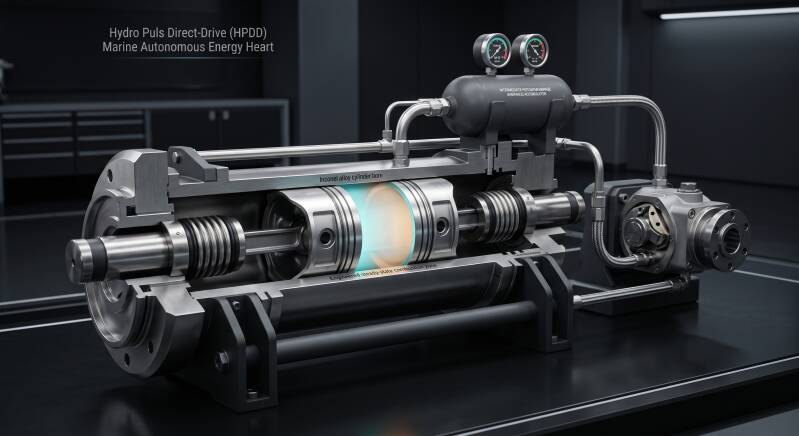
The Autonomous Energy Heart: Direct Hydraulic Displacement Architecture
In conventional propulsion design, the engine is physically hostage to the propeller. When a heavy sea slams the hull or the vessel begins harbor maneuvering, shaft torque spikes travel straight into the cylinders, destabilizing thermal equilibrium.
The Hydro Puls Direct-Drive (HPDD) architecture ends this vulnerability by turning the combustion core into an "Autonomous Energy Heart."
Instead of converting gas expansion into mechanical rotary momentum, HPDD translates discrete thermal pulses directly into stiff, closed-loop hydraulic displacement.
---
The Mechanics of the Linear HPDD Core
The architecture discards connecting rods, crankshafts, and rotary crossheads in favor of a balanced linear volumetric core:
1. Opposed-Piston Linear Expansion (2 Pairs)
Combustion occurs symmetrically between horizontally opposed pistons (arranged in opposed pairs). Because gas pressure acts equally in opposite directions, internal forces are fully self-canceling. There are zero connecting-rod angularities, eliminating lateral side-thrust against cylinder liners and drastically reducing mechanical friction.
2. Isolated Thermal Steady-State (230 °C Calibration)
Because the core is mechanically decoupled from the shaft, it never throttles or lugs with wave action. The cylinder bore and piston assemblies run continuously at their engineered 230 °C thermal-mechanical calibration. This precise boundary control ensures uniform clearances, optimal ring sealing, and complete combustion kinetics—even with stubborn, slow-flame carriers like green ammonia.
3. Stiff Volumetric Transfer & Capacitive Buffering
Each linear combustion stroke directly displaces hydraulic fluid through a closed circuit into an intermediate accumulator bank. Sized with a dedicated gas pre-charge (p0 = 0.75 · p_min), this hydraulic capacitor serves two critical functions:
• It absorbs high-frequency displacement pulses, delivering smooth, continuous hydraulic power downstream.
• It acts as a dynamic hydraulic damper, clamping cyclic differential pressure across critical sealing bellows strictly within Δp ≤ 5 bar.
---
The Thermodynamic Payoff: The Combustion Core Never Sees the Sea
By inserting high-density fluid capacitance between thermal combustion and shaft propulsion, the operational paradigm shifts:
• The Propeller demands variable torque and rapid directional changes.
• The Hydraulic Motor (variable swashplate PTI) delivers instantaneous torque response at 350–420 bar.
• The HPDD Core does not notice. It operates strictly in its narrow, peak BMEP sweet spot at steady frequency and temperature.
The result is a marine powerplant that refuses to sacrifice conversion efficiency to transient hydrodynamic loads. High-grade thermal energy is converted with hydraulic stiffness, buffered safely, and delivered precisely when the propeller demands it.
Decouple the thermal heart from the hydrodynamic load, and your retrofit achieves true thermodynamic resilience.
---
For marine powertrain engineers and fleet managers: When evaluating alternative fuel systems, how are you isolating your thermal combustion core from wave transients and rapid load-shedding events?
#MarineEngineering #Decarbonization #MaritimeRetrofit #HydroPulsDirectDrive #FluidPower #NavalArchitecture #GreenShipping #Powertrain