The Myth of the Drop-In Fuel: Why the Drivetrain Dictates the Business Case
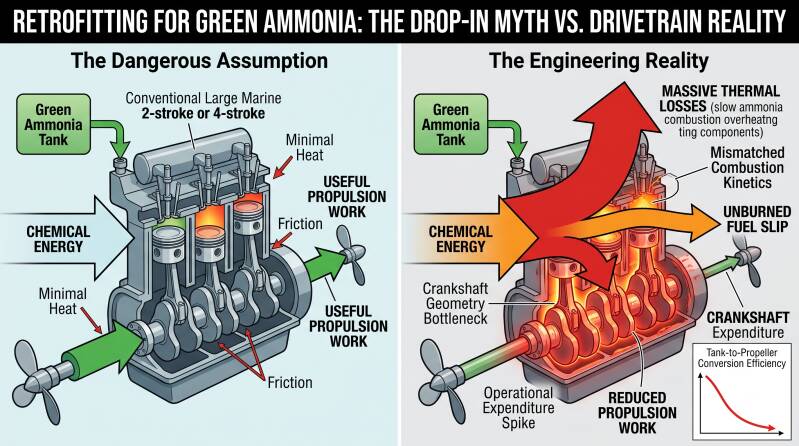
Bolting an alternative fuel skid onto a conventional marine rotary engine is not a decarbonization strategy,it is an unhedged balance sheet risk.
The industry discourse remains disproportionately fixated on fuel availability: green ammonia vs. methanol, bunkering corridors, and supply-chain readiness. Yet we bypass the foundational thermodynamic reality sitting inside the hull:
The conventional marine internal combustion engine was mechanically sculpted around the combustion physics, energy density, and flame characteristics of heavy fuel oil and MGO.
When you introduce alternative energy carriers into a rigid crankshaft-driven rotary architecture, the physics push back immediately:
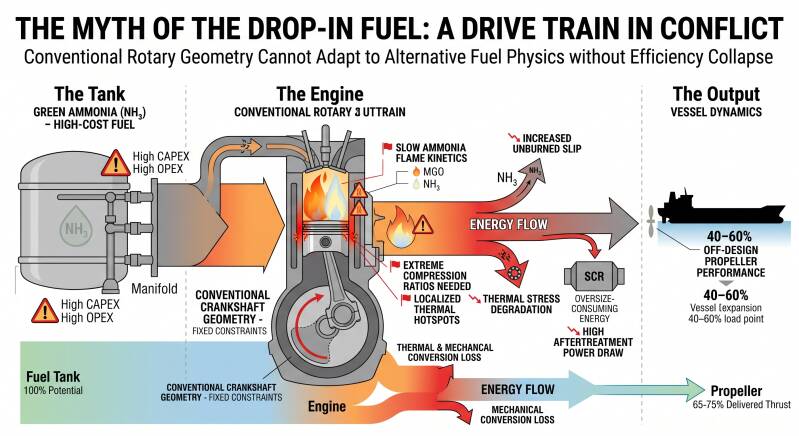
Mismatched Combustion Kinetics: Green ammonia exhibits a laminar flame speed nearly an order of magnitude slower than marine gas oil. Forcing slow kinetics into the fixed mechanical transit times of rotating connecting rods forces severe trade-offs between unburned fuel slip and excessive peak pressures.
Thermal & Mechanical Degradation: Compensating for ignition delays requires aggressive pilot injection, extreme compression ratios, or elevated in-cylinder temperatures. The result: accelerated cylinder liner stress, localized thermal hot spots, and increased parasitic power draws from oversized aftertreatment loops.
The Compounding Off-Design Penalty: The moment a vessel deviates from its narrow Maximum Continuous Rating (MCR) sweet spot, conversion efficiency drops sharply. Burning green fuels, which cost 2x to 4x more per megajoule than fossil baselines, inside a drivetrain operating at degraded off-design efficiency destroys charter margins.
A drop-in fuel approach assumes that the drivetrain is an agnostic consumer of chemical energy. It is not. If your tank-to-propeller conversion efficiency collapses by 15–20% across real voyage profiles, operational expenditures erase the underlying investment thesis.
True maritime decarbonization does not begin at the bunker manifold; it begins at the shaft line.
For technical directors and fleet superintendents: When modeling 10-year retrofit investments for alternative fuels, how are you factoring in the compounding financial penalty of mechanical drivetrain conversion losses during part-load operational hours?
#MarineEngineering #Decarbonization #MaritimeRetrofit #NavalArchitecture #AlternativeFuels #HydroPulsDirectDrive #Shipping