

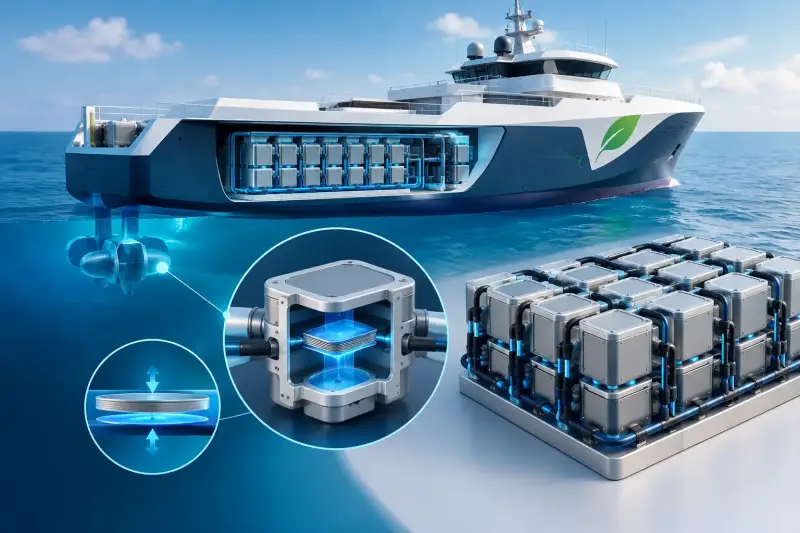
Marine Propulsion Decarbonization: HPDD Case Study (12 MW)
A vessel does not decarbonize simply by installing an alternative fuel tank. It decarbonizes when its full energy architecture, conversion, propulsion, auxiliary loads, and thermal management, operates as one engineered system.
This case study of a 12 MW deep-sea vessel demonstrates why the propulsion train dictates whether shifting to ammonia or hydrogen is economically viable or merely transfers onboard complexity.
The Conventional Baseline Penalty
Standard marine powertrains rely on medium-speed gensets, power electronics, propulsion motors, and reduction gearing.
Every conversion stage introduces losses. Crucially, operations at partial load, maneuvering, and variable sea states push prime movers away from their optimal efficiency envelope. With expensive future fuels such as green ammonia or hydrogen wasting converted energy directly undermines commercial viability.
The Direct-Drive Architecture (HPDD)
Replacing the mechanical crankshaft, the Hydro Puls Direct Drive (HPDD) pairs isolated combustion pulses directly with a stiff hydraulic energy-transfer loop, operating as an "Autonomous Energy Heart":
* Thermal Decoupling: Modular HPDD energy cores run continuously at their peak thermal efficiency point. Transient propeller torque demands and weather-induced load spikes are buffered dynamically by hydraulic accumulators.
* Low-Speed, High-Torque Delivery: The hydraulic propulsion motor delivers maximum torque at low propeller RPM without mechanical transmission friction or thermal cycling of the combustion core.
* True Modularity: At cruising speed, only the required modules operate under optimal load. During low-demand periods, surplus units shut down cleanly rather than dragging the entire system into inefficient partial-load regimes.
Fuel Pathways: Ammonia First, Hydrogen Optionality
* Ammonia: Delivers carbon-free tank-to-wake operation as an easily stored liquid. The isolated combustion chamber provides tight boundary control over pressure and temperature, eliminating unburned slip and minimizing NO_x and N_2risks.
* Hydrogen: Well-suited for short-sea corridors. The modular HPDD architecture eliminates stranded-asset risk: the core hydraulic propulsion train remains unchanged while fuel conditioning skids adapt.
Value Creation & Deployment Gates
* Parasitic Loss Reduction: Eliminates mechanical crankshaft friction, gearboxes, and multi-stage electrical conditioning losses.
* Thermal Integration: High- and low-grade waste heat is directed to onboard fuel conditioning, cargo heating, and auxiliary services.
* Engineering Milestones: Full-scale adoption requires high-resolution operational duty-cycle logging, Hardware-in-the-Loop (HIL) simulations, ammonia HAZOP reviews, and land-based demonstrator validation prior to yard integration.
Marine decarbonization transitions from a fuel announcement into an investable, bankable asset when the fuel-to-propeller powertrain is engineered for real-world operating profiles.