Handling 9,500 m³ of Aggressive Frac Flowback:
Why Physics Must Replace Chemical Overdosing.
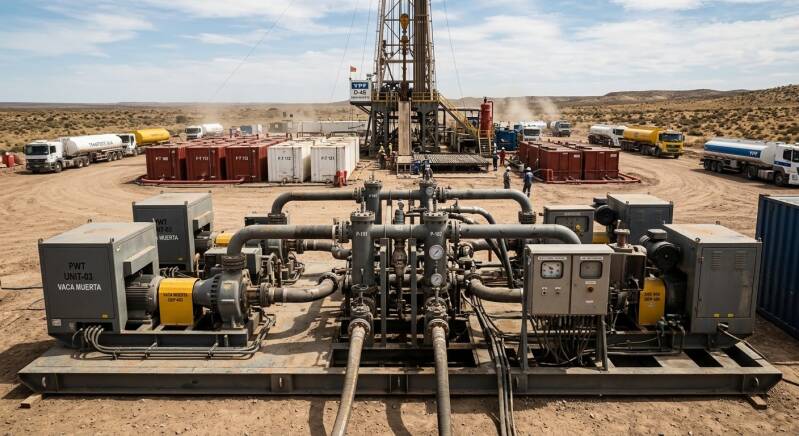
In unconventional operations, such as developing tight shale plays in Argentina the first 6 days of well flowback dictate field economics and environmental compliance.
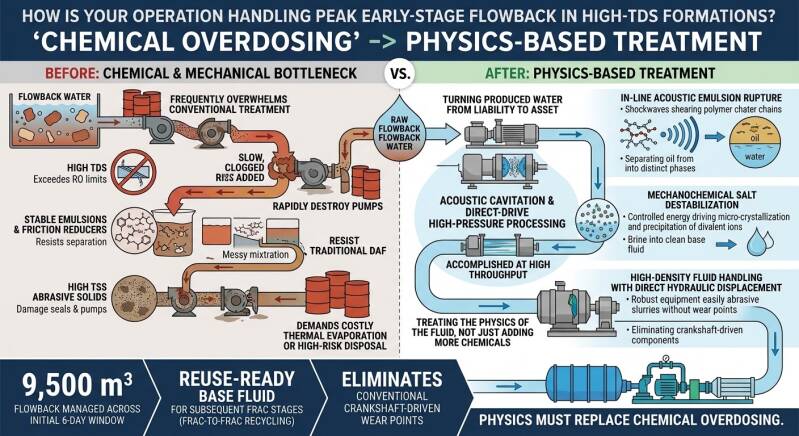
Sourcing and managing a surge of 9,500 m³ across the initial 6-day window (~1,580 m³/day or ~66 m³/h) presents an operational bottleneck that frequently overwhelms conventional water treatment:
High Total Suspended Solids (TSS): Residual proppant fines and formation silt rapidly destroy standard mechanical seals and positive displacement pump components.
Stable Emulsions & Friction Reducers: Complex polyacrylamide chains (slickwater) paired with dispersed free hydrocarbons resist traditional dissolved air flotation (DAF).
Hypersaline Chemistry (Extreme TDS): Total dissolved solids quickly exceed the physical osmotic pressure limits of membrane filtration (RO), demanding costly thermal evaporation or high-risk disposal wells.
Acoustic Cavitation & Direct-Drive High-Pressure Processing
Rather than relying on chemical dosing or vulnerable polymer membranes, processing high-volume produced water at high throughput relies on direct fluid mechanics:
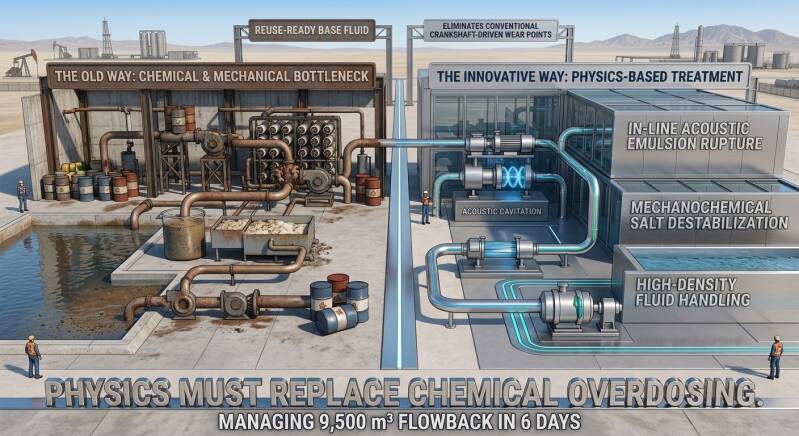
In-Line Acoustic Emulsion Rupture: High-energy acoustic shockwaves shear long-chain friction-reducing polymers and destabilize oil-water emulsions instantly, enabling rapid phase separation without excessive coagulants.
Mechanochemical Salt Destabilization: Controlled acoustic energy drives micro-crystallization and precipitation of heavy divalent ions, transforming unmanageable brine into reuse-ready base fluid for subsequent fracturing stages (frac-to-frac recycling).
High-Density Fluid Handling: Operating with direct hydraulic displacement eliminates conventional crankshaft-driven wear points, easily processing abrasive, high-density slurries under continuous load.
Turning produced water from a disposal liability into a closed-loop asset requires treating the physics of the fluid, not just adding more chemicals.
How is your operation handling peak early-stage flowback in high-TDS formations?
#OilAndGas #ProducedWater #Fracking #WaterTreatment #AcousticCavitation #DirectDrive #VacaMuerta #EnergyTransition #CircularEconomy