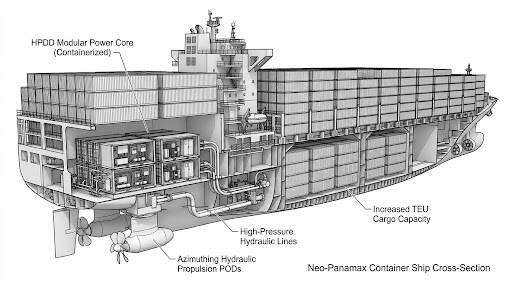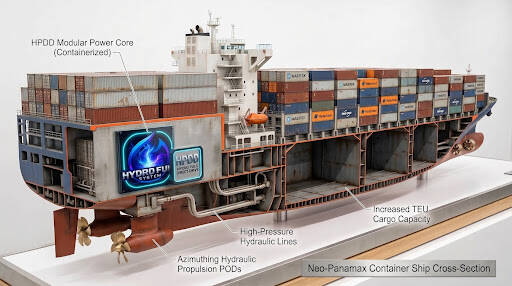
Conventional marine propulsion remains constrained by mechanical legacies: bulky low-speed diesels, massive intermediate shafts, vulnerable rudder stocks, and heavy reduction gearboxes that consume huge portions of the cargo hold.
Direct fluidic power via the Hydro Puls Direct-Drive (HPDD) architecture breaks this paradigm completely:
- Boundary Layer Uptake (BLU) Integration: With rigid mechanical shafts eliminated, flexible high-pressure fluidic lines deliver drive power precisely where hydrodynamic intake is most effective, turning boundary layer ingestion into an operational reality.
- Compact Propellers & Ultra-Slim Pods: Extreme fluidic torque density drives smaller, highly responsive propeller assemblies. Because bulky electric motors are removed from submerged housings, external pods remain ultra-narrow, slashing hydrodynamic drag.
- Zero Rudder Assemblies: Direct thrust vectoring via steerable pods delivers unmatched maneuvering agility. The rudder blade, mechanical stock, and steering gear are engineered out of the hull entirely.
- 99.999% Swarm Uptime: Instead of relying on a single catastrophic point of failure in a main engine block, HPDD deploys as a decentralized modular swarm. Individual units can be serviced without degrading vessel transit speed.
- Space Optimization & Payload Expansion: Removing massive crankshafts, reduction gears, and expansive lube-oil skids frees up valuable lower-hull volume directly for commercial freight or passenger accommodation.
- Drastically Lower CapEx & OpEx: Simplified hull integration, fewer mechanical wear parts, and zero metal-to-metal contact cycles significantly reduce upfront build costs and eliminate recurrent drydock overhauls.
- Zero Toxic Emissions: Hermetically sealed, natively compatible with clean synthetic carriers (such as hydrogen and ammonia), and operating without toxic mineral hydraulic oils.
True maritime decarbonization does not come from reinforcing 20th-century mechanical drivetrains—it begins with fluidic direct-drive efficiency.
#NavalArchitecture #MarineEngineering #HPDD #GreenShipping #MaritimeInnovation #CleanTech #VesselDesign #Decarbonization #ShipBuilding