

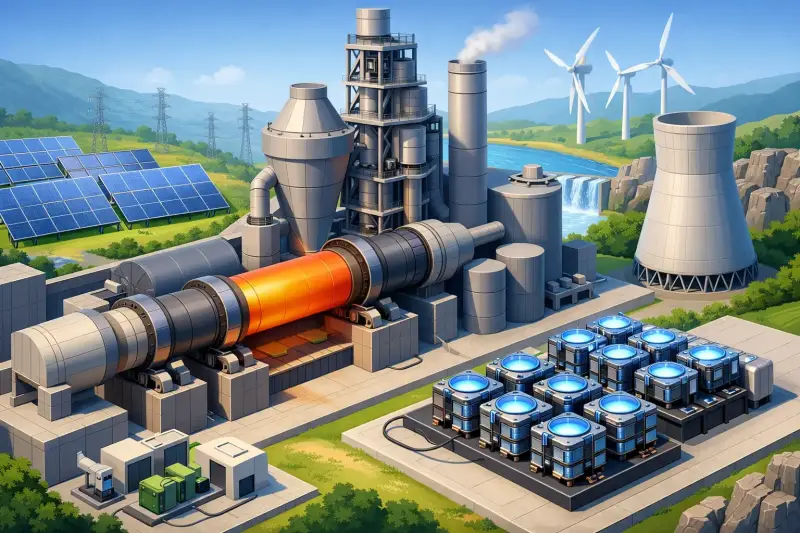
How Cement Plants Cut Power Costs at the Kiln:
An Industrial Energy System Approach.
A cement plant does not lose money on electricity only when tariffs rise. It loses money when grinding circuits run inefficiently, fans throttle against false air, and peak-demand purchases erode margins. Typical electrical intensity ranges from 90 to 130 kWh per ton of cement; real savings come from treating energy as an integrated process variable rather than a fixed overhead cost.
1. Optimize Grinding: Focus on Specific Energy (kWh/ton})
Raw and finish grinding account for the largest share of power consumption. The objective is not simply reducing motor kW, but maximizing kWh/ton} of saleable, on-spec product:
Circuit Tuning: Poor separator settings, unmanaged recirculating loads, and improper mill ventilation force plants to regrind the same material repeatedly.
Process Stability: High-resolution control stabilizes feed rates, bed depth, and differential pressure, avoiding wasteful swings in vertical roller mills and roller presses.
2. Cut Fan Power & Eliminate False Air
Induced-draft, kiln, cooler, and baghouse fans are massive energy consumers. Because fan power scales steeply with volume, addressing system aerodynamics delivers outsized returns:
False Air Penalties: Ingress through kiln seals, preheaters, and ductwork forces fans to move dead gas volume while destabilizing combustion and degrading waste heat quality.
System Geometry: Duct redesign, damper elimination, and sealing often yield higher returns than merely adding variable-frequency drives to leaking circuits.
3. Strategic Load Scheduling & Tariff Management
Defer non-continuous loads, such as finish grinding, secondary crushing, and bulk handling, away from peak tariff hours.
Ensure real-time operational visibility across mill-specific \text{kWh/ton}, compressor demand, and dispatch storage to turn peak avoidance into a repeatable process.
4. Integrated Waste Heat Recovery (WHR)
Evaluate WHR on net generation (accounting for pumps, parasitic loads, and downtime) rather than nameplate capacity.
Model the complete thermal cascade to ensure kiln exhaust and cooler heat prioritize the highest-value duty: drying, alternative fuels, carbon capture, or power generation.
5. Replace Conversion Losses with Direct-Drive Architecture
Converting fuel to heat, heat to shaft power, shaft power to grid electricity, and electricity back into mechanical/hydraulic work causes compounding conversion losses.
Hydro Puls Direct-Drive (HPDD): Decouples the combustion/generation core from rapid load swings, running at peak efficiency while delivering direct hydraulic work and usable process heat to heavy loads, mills, and capture packages without rotating crankshaft losses.
The lowest-cost kilowatt-hour is not merely the cheapest on the tariff sheet, it is the one that delivers stable clinker, maximizes specification-grade output, and eliminates parasitic losses across the site.