

Day 1 of 10: The Core Marine Vulnerability
[Launching our 10-Day Deep Dive: sCO2 Marine Damping & HPDD v26 Architecture]
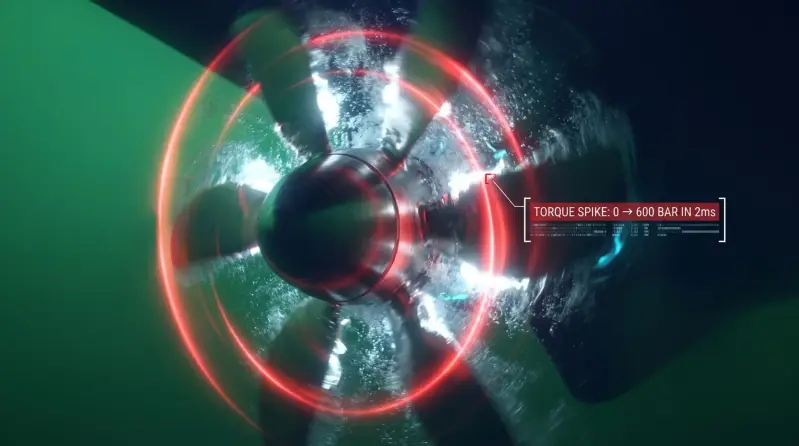
In heavy, pitching seas, vessel propellers are routinely lifted out of the water column. The split second the spinning screw re-submerges, it encounters an instantaneous wall of dense water. The result is a brutal hydrodynamic step-overload: violent torsional shock waves, immediate cavitation spikes, and massive torque transients traveling up the drivetrain.
Conventional marine drivetrains attempt to fight this physics with brute mass: thick shafts, massive reduction gearboxes, and reinforced crankshaft bearings. Yet no amount of steel can completely insulate rotating gear teeth and mechanical journals from cycle fatigue, accelerated wear, and the constant risk of catastrophic shearing during open-ocean storms.
Within our Hydro Puls Direct-Drive (HPDD v26) architecture, we are pioneering a fundamentally superior path: the PulseCore sCO2 Dynamic Energy Buffer. Rather than allowing raw hydro-kinetic shocks to bash against rigid mechanical assemblies, we intercept and dampen the energy purely through high-density fluid dynamics.
Extreme maritime environments are not conquered by heavier mechanical linkages—they are tamed through advanced thermodynamics.
➡️ Tomorrow for Day 2: The Physics of Supercritical CO2: How operating near the critical point eliminates cavitation and hydraulic water hammer entirely.
#MaritimeEngineering #HPDD #Propulsion #CleanTech #MarineInnovation #DeepTech