

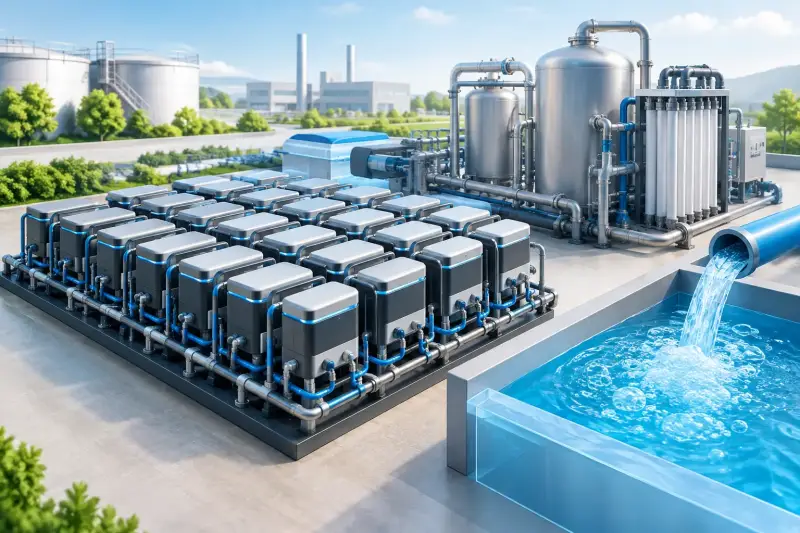
A Combined Heat and Power (CHP) plant can be far more than an electrical generator with a heat-recovery skid. In water-constrained industries, it can become a foundational pillar of the site's water balance. Combustion of hydrogen-bearing fuels (such as methane, hydrogen, biogas, and ammonia carriers) inherently forms water vapor.
While conventional CHP systems vent this moisture through the stack, a condensing architecture captures both latent heat and liquid water. A single fuel input thereby delivers three critical utility streams: dispatchable power, process heat, and process water.
Water as an Engineered Specification
The theoretical recovery potential is substantial: one pound of methane forms approximately 2.25 pounds of water, while one pound of hydrogen yields nine pounds. However, actual condensate recovery depends on exhaust gas temperature, excess air, and crucially, an available low-temperature heat sink (such as building loops, greenhouse heating, or absorption cooling circuits).
Combustion condensate offers an immediate advantage: very low dissolved minerals, hardness, and salts compared to raw groundwater or municipal intake. Yet, it is not instantly process-ready. Absorbed acidic gases require treatment. An effective water-recovery train must be designed backward from the point of use—whether for cooling-tower makeup, boiler feedwater, or reverse osmosis pre-treatment—combining particulate filtration, pH neutralization, and selective polishing.
The Thermodynamic Cascade
Recovering maximum water requires deeper flue-gas cooling, which represents a thermodynamic trade-off. The optimal design relies on a site-wide thermal cascade:
High-grade heat supplies process steam or high-temperature duties.
Medium-to-low-grade heat serves secondary industrial warming or space conditioning.
The final temperature drop forces flue-gas condensation and liquid water extraction.
The Hydro Puls Direct-Drive (HPDD) Advantage
Traditional combustion gensets are constrained by rotating crankshafts, part-load performance penalties, and rigid heat recovery. The HPDD platform circumvents these limitations:
Fluidic Decoupling: Core combustion energy transfer is decoupled from mechanical shaft friction and rotating mass constraints.
Integrated Polygeneration: The autonomous energy core delivers direct fluidic/hydraulic work while managing precise thermal streams for condensation, chilling, and water purification circuits.
Future-Fuel Optimization: Perfectly matched for hydrogen- and ammonia-based vectors, turning clean combustion by-products into high-value on-site water.
Conclusion
For cement, chemicals, refining, data centers, and heavy industry, condensing CHP transforms from a dual-output machine into unified utility infrastructure. Integrating power, heat, and water into a single asset mitigates utility exposure and fundamentally de-risks plant operations.