

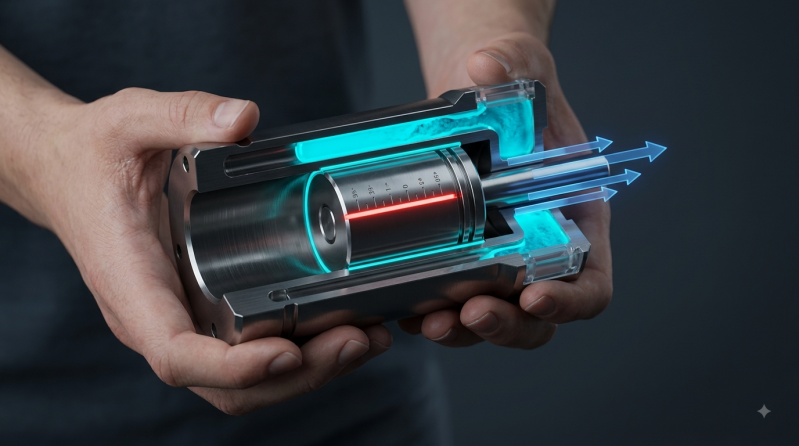
The Physics Behind the Force: How a 40 mm Piston with a 1.2 mm Stroke Delivers 600 BAR at 100 Hz.
At first glance, it sounds like an engineering paradox: a compact piston with a diameter of just 40 millimeters and an ultra-short stroke of 1.2 millimeters generating a continuous peak pressure of over 600 bar.
Why does the HPDD achieve this in a lightweight, hand-carried footprint?
The answer lies in first-principles mechanics, fluid incompressibility, and high-frequency dynamic acceleration.
1. Direct Axial Force Alignment
Pressure is simply force concentrated over a specific surface area. Because a 40 mm piston has a relatively small surface area, generating 600 bar requires approximately 7.7 metric tons of linear thrust.
In traditional machines, transferring that much force requires heavy rotating linkages, which introduce severe side loads and friction against cylinder walls. Within the HPDD core, the movement is purely linear. Every ounce of combustion or expansion force pushes in a straight line directly into the fluid, with zero crankshaft angles, zero side-thrust, and zero leverage losses.
2. Fluid Incompressibility
Hydraulic fluids and water are virtually incompressible. To ramp a trapped volume of fluid from ambient pressure up to an extreme 600 bar, you only need to reduce its volume by about two to three percent.
The pressure spikes to 600 bar in the first fraction of the movement, pushing the fluid straight through the outlet valves for the rest of the stroke.
3. The Multiplier Effect of 100 Hz
While a 1.2 mm stroke moves a small volume of fluid in a single pass, cycling 100 times per second completely transforms the output.
Industrial Flow Rate: Repeating that tiny displacement 100 times every second produces a steady, continuous flow of 600 bar from a single chamber.
Massive Power Density: That continuous high-pressure delivery translates to over nine kilowatts of pure hydraulic work from a single piston, scaling rapidly to tens of kilowatts in opposed-piston configurations that fit in a package you can carry with two hands.
4. Why Conventional Pumps Cannot Match This:
Zero Bearing Breakdown: Slamming nearly eight tons of load into mechanical journal bearings 100 times every second causes rapid metal fatigue and failure. HPDD replaces mechanical bearings entirely by floating the linear core on a frictionless hydrodynamic water layer.
No Internal Leakage: Because each stroke happens in just five milliseconds, the fluid literally does not have enough time to slip through the micron-scale clearances before the work stroke is finished.
Zero Cylinder Distortion: With no rotating crank pushing the piston sideways, cylinder bores remain perfectly round, ensuring an indefinite operating life.
A compact piston keeps the total required force manageable, fluid incompressibility makes a 1.2 mm stroke completely sufficient, and a 100 Hz linear cycle delivers true industrial-scale flow.
#HPDD