

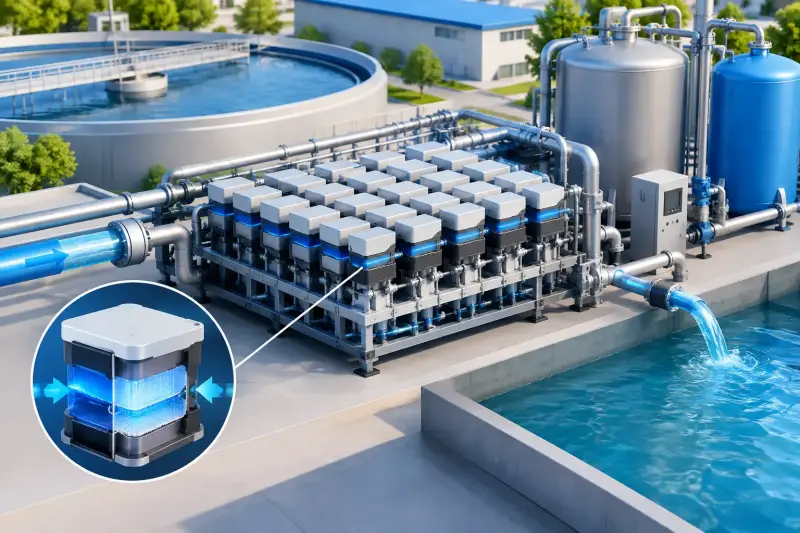
A water constraint is rarely just a water constraint. In cement plants, refineries, data centers, and industrial facilities, it caps throughput, inflates cooling budgets, and converts a predictable utility into a volatile operational expense. Water recovery solves this vulnerability by treating water as an energy-integrated process output rather than a purchased commodity.
The core question is not whether water can be recovered, but which source provides the lowest energy penalty at the required purity and uptime.
Four Recoverable Industrial Water Streams
Combustion Water & Flue-Gas Condensate: Hydrogen, hydrocarbon, and ammonia systems generate water vapor natively as a combustion byproduct. Condensation yields high-value boiler feed or cooling make-up, economically viable only when cooling is supplied via integrated thermal cycles rather than parasitic electrical chillers.
Atmospheric Moisture (AWG): Highly effective in regions with stable humidity and steep water trucking costs. In data centers and greenhouses, integrating air handling, cooling, and water capture directly supports climate control while offsetting fresh intake.
Process Water, Blowdown & Effluent: Cooling tower blowdown, equipment wash water, and industrial run-off represent the largest on-site reserves. Implementing a water-quality cascade prevents costly overtreatment by routing ultra-pure streams to steam boilers and lower-grade fractions to dust suppression or washing.
Brackish & Seawater Desalination: Guarantees supply independence from municipal networks. Beyond kilowatt-hours per cubic meter, the true business case hinges on membrane fouling rates, intake permits, and brine concentrate disposal.
The Water-Energy Architecture
Traditional facilities treat water treatment and energy generation as siloed utilities, incurring massive conversion losses. High-pressure pumps, evaporators, and cooling systems achieve peak efficiency only when directly integrated with the primary power core.
The Hydro Puls Direct-Drive (HPDD) platform breaks this fragmentation:
Stable Thermodynamic Core: An isolated reaction zone runs continuously at its optimal thermodynamic sweet spot, decoupled from fluctuating process loads.
Direct Fluidic Conversion: Ultra-high pressure drives reverse osmosis and process pumps hydraulically without rotational mechanical-to-electrical conversion penalties.
True Polygeneration: A single modular unit simultaneously outputs dispatchable power, high-pressure hydraulics, industrial heat, continuous chilling, and high-purity water.
Project Economics & Water Autarky
A sound financial model looks beyond membrane capital expenditure. The real payback comes from eliminated water procurement and trucking, reduced wastewater discharge fees, and the mitigation of costly downtime during grid curtailments or drought restrictions.
Industrial water resilience does not require another standalone machine; it requires an energy architecture engineered to make its enthalpy and pressure work twice.
#WaterRecovery #CleanTech #HPDD #ProcessEngineering #CircularEconomy #WaterScarcity #IndustrialEnergy #ZeroLiquidDischarge #Sustainability