

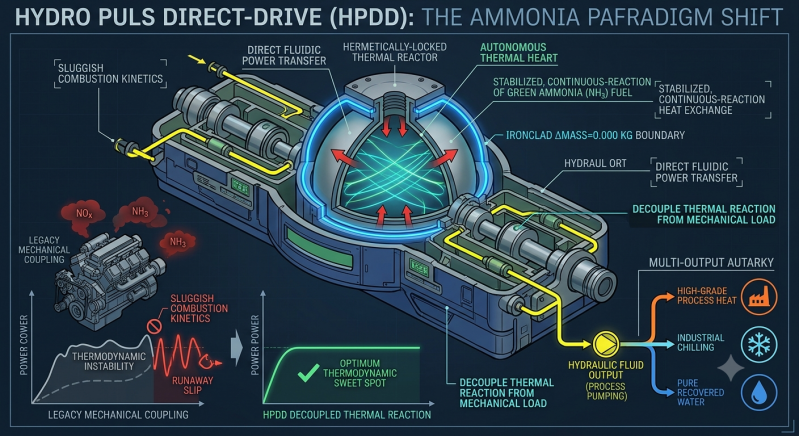
Ammonia is not simply an alternative fuel waiting to be dropped into an existing internal combustion engine. It is a demanding chemical litmus test that exposes every structural weakness in legacy thermal architecture.
As an energy carrier, ammonia unlocks profound logistical advantages: it moves hydrogen across global supply chains without cryogenic boil-off penalties or extreme gas compression, leveraging existing worldwide terminal infrastructure. But burning it inside a conventional crankshaft engine or gas turbine hits severe thermodynamic walls:
Sluggish Combustion Kinetics: Low flame velocity, high autoignition temperatures, and a narrow flammability window make flame stability under variable partial loads an operational nightmare.
The Emissions Paradox: High combustion temperatures drive intense thermal NO_x formation, while incomplete reaction creates toxic ammonia slip and potent N_2O greenhouse emissions.
Toxic Containment: A molecule this hazardous tolerates zero crankcase breathers, valve-stem seepage, or lubricant cross-contamination.
The fatal flaw in legacy systems is mechanical coupling. When industrial loads fluctuate, the combustion chamber is pulled out of its narrow thermodynamic sweet spot. The result: unstable flame fronts, runaway slip, and collapsing efficiency.
The Solution: Decouple Thermal Reaction from Mechanical Load.
The Hydro Puls Direct-Drive (HPDD) platform breaks this 300-year-old mechanical dogma entirely:
Autonomous Thermal Heart: Fuel conversion operates inside a hermetically locked environment held at its continuous thermodynamic optimum, eliminating open crankcases and fugitive emissions under an ironclad boundary.
Direct Fluidic Power: Expansion work is transferred straight to high-pressure hydraulics. The fluid matrix absorbs dynamic load spikes instantly without perturbing core reaction kinetics.
True Multi-Output Autarky: Instead of merely competing on wholesale electricity margins, the system monetizes the complete enthalpy profile: direct fluid pumping, high-grade process heat, industrial chilling, and pure recovered water.
The winners of the energy transition will not be those retrofitting legacy diesel blocks with massive catalytic scrubbers and claiming to be "ammonia-ready." The winners will be the operators who recognize that a demanding 21st-century molecule requires a fundamentally new conversion paradigm.
Stop forcing next-generation molecules through 18th-century crankshafts.
#CleanTech #Ammonia #HPDD #EnergyTransition #DeepTech #ProcessEngineering #Decarbonization #DirectDrive #Innovation