

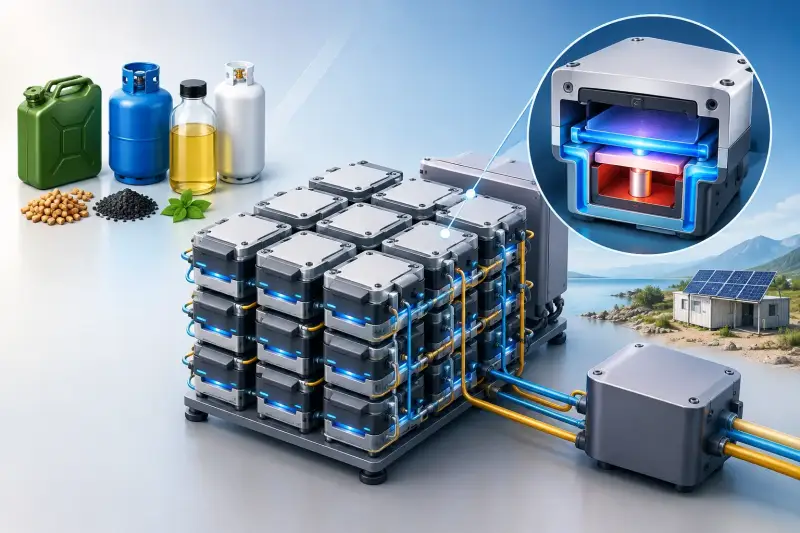
A fuel decision can lock an industrial asset into decades of fuel handling, permitting exposure, and operating cost. The central question for isolated combustion is not simply heating value, but which fuel releases energy predictably in a controlled environment while preserving efficiency, asset life, and future conversion options.
In conventional systems, combustion, machinery, and load response are tightly coupled. Isolated combustion decouples them: combustion operates at a stable design point while power transfers via intermediate systems, such as hydraulics.
This lets engineering optimize for thermodynamics rather than transient load behavior.
Key Fuel Profiles:
Natural Gas: The pragmatic baseline. Highly metered, zero ash, and supported by mature infrastructure.
It offers a low-complexity bridge for dispatchable power and CHP, provided the system is designed for future conversion.
Renewable Natural Gas & Biomethane: Leverages existing gas infrastructure for sites near digesters or landfill assets. Consistent conditioning is essential to handle contaminants like siloxanes and moisture.
Hydrogen: Maximum decarbonization with zero use-point CO2. Fast kinetics and high flame speeds require precise injection, mixing, and metallurgy, but controlled environments manage these demands effectively.
Ammonia: The carbon-free fuel built for global logistics. Storing hydrogen more densely by volume than compressed gas, it suits shipping and remote hubs.
Slower flame speeds and NOx/slip control are managed best when combustion is insulated from downstream load swings.
Methanol & E-Fuels: Deliver liquid-handling convenience without cryogenic or high-pressure storage, offering strong transitional utility where lifecycle carbon accounting aligns.
System Alignment Over Single-Fuel Bets
Selecting fuel before defining system outputs is a major capital-planning error.
Fuel value depends on the complete output mix: power, direct hydraulic pumping, process heat, cooling, or water recovery.
Hydro Puls Systems addresses this through the Hydro Puls Direct-Drive (HPDD) architecture: a pulse-based isolated combustion environment coupled to hydraulic energy transfer rather than a conventional crankshaft. By keeping the core in its ideal operating window and absorbing variations hydraulically, the practical fuel envelope expands, especially for hydrogen and ammonia.
The ultimate goal is building a fuel roadmap rather than a stranded asset. A flexible platform can commission on natural gas, integrate biomethane, and transition to hydrogen or ammonia as supply chains mature.
#EnergyTransition #CleanTech #Hydrogen #Ammonia #HPDD #PowerGeneration #IndustrialDecarbonization #ThermalEngineering #EnergyArchitecture #SustainableIndustry