

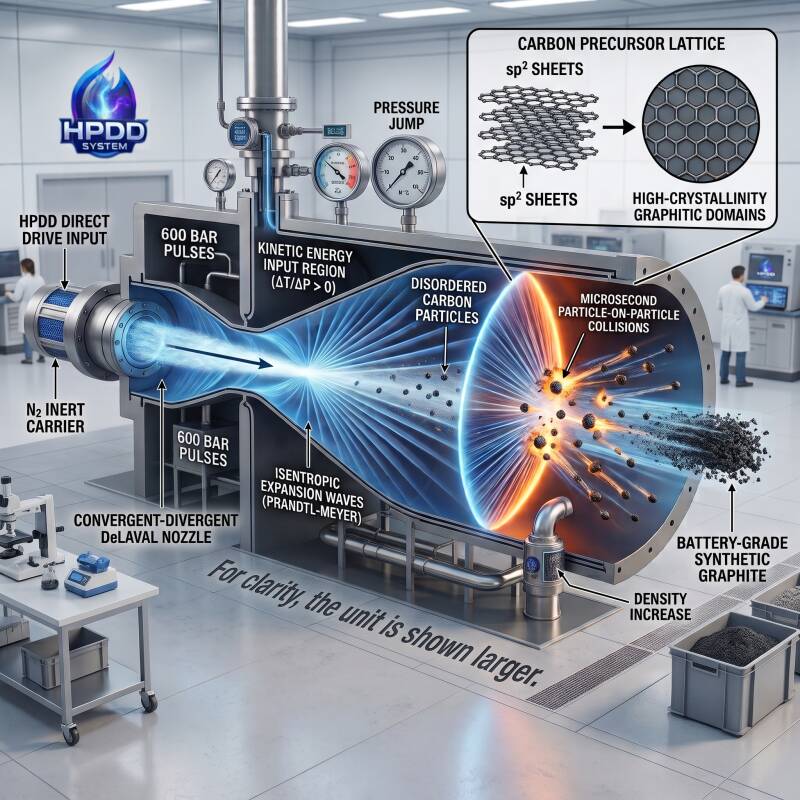
💥 The Physics Behind the Shockwave: How the Atomic Eraser Works
We frequently receive the question: "Do shockwaves actually form inside the reactor, and how does that work without moving grinding parts?"
The short answer: applied gas dynamics and non-linear compressible flow.
Instead of mechanical milling or multi-week thermal baking cycles, the closed-loop HPDD platform orchestrates a sequential two-stage fluid dynamic process:
1. Isentropic Expansion (De Laval & Prandtl-Meyer Waves)
The process begins by feeding the inert Nitrogen carrier (N2) through custom convergent-divergent De Laval nozzles, accelerating the gas matrix past Mach 2.5. This triggers a steep Prandtl-Meyer expansion fan.
👉 The mechanism: The rapid flow acceleration induces a severe localized static pressure drop and centerline vacuum, drawing disordered carbon particles into the core stream with high momentum.
2. Shockwave Compression & Kinetic Dissipation (Rankine-Hugoniot Discontinuities)
When this supersonic particulate suspension encounters controlled backpressure boundaries or high-frequency +600 bar hydrodynamic pulses, the fluid cannot decelerate continuously. It collapses into a normal/oblique shock front, a physical discontinuity measured in sub-millimeter thickness.
👉 The mechanism: Governing Rankine-Hugoniot jump equations dictate an instantaneous surge in local pressure, density, and kinetic dissipation within nanoseconds.
⚡ What Happens to the Carbon Precursor?
The extreme acoustic decompression and localized shear gradients trigger intense particle-on-particle collisions:
* Contactless De-Ashing: Inertial density differences between inorganic mineral inclusions (silica, metallic oxides) and the carbon matrix tear impurities loose mid-air without acid leaching.
* Mechanochemical Lattice Ordering: Highly concentrated boundary-layer energy input drives the microsecond reordering of disordered sp² carbon sheets into high-crystallinity graphitic domains.
By precisely tuning supersonic expansion against boundary shock compression, fluid kinetic energy replaces brute-force thermal heating to deliver battery-grade synthetic graphite.
#GasDynamics #FluidMechanics #Shockwaves #MaterialScience #SyntheticGraphite #ProcessEngineering #DeepTech #AppliedPhysics