

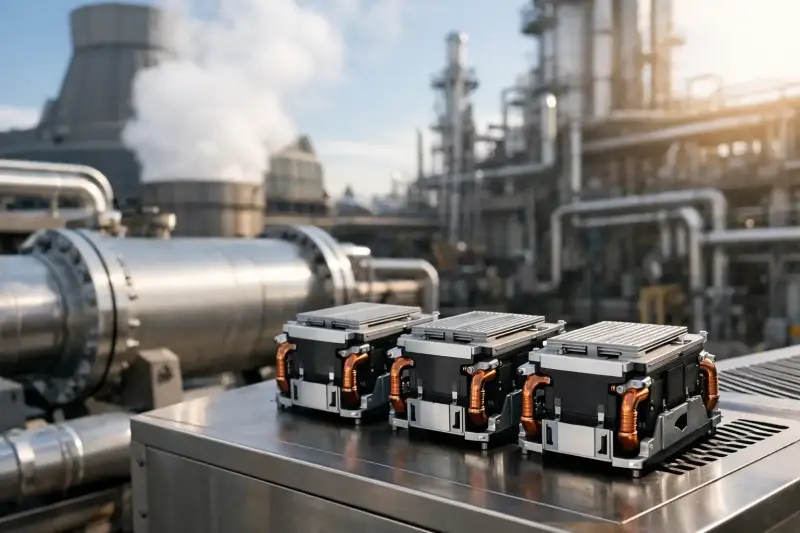
What an industrial waste heat recovery system actually does
At its core, the system captures thermal energy from a high-temperature or medium-temperature source and routes it into a conversion pathway with higher economic value than simple rejection. In practice, that pathway can be steam generation, hot water production, organic Rankine cycle power, absorption cooling, combustion air preheat, feedwater heating, drying, desalination support, or direct mechanical and hydraulic work.
The quality of the heat matters more than the quantity alone. A 900 F exhaust stream and a 220 F water loop are not interchangeable energy sources, even if their total heat content looks similar on paper. Exergy, not just enthalpy, determines what the plant can realistically recover. High-grade waste heat may support electric generation. Lower-grade heat may be better assigned to preheating, district thermal service, greenhouse applications, or integrated water production.
The strongest projects start with pinch analysis and site load mapping, not equipment brochures. If the plant cannot identify when heat is available, at what temperature, with what contaminants, and against which real load profile, it is not ready to specify hardware.
Why conventional recovery projects underperform
Many systems are sized around nameplate heat rather than usable heat. That error appears early and quietly. Stack gas temperature may be quoted at one operating point while the process spends most of its time far below that level. A refinery heater, cement line, or reciprocating engine rarely lives at ideal steady state. Once part-load behavior enters the picture, the recovery plant may spend much of the year chasing a moving target.
Another issue is parasitic load. Fans, pumps, condensers, water treatment skids, control systems, and pressure-drop penalties can consume a meaningful share of the recovered energy. A project that looks efficient in gross thermal terms can disappoint badly in net output.
Then there is the conversion chain itself. Every intermediate step adds losses, response lag, maintenance points, and CAPEX. Heat to steam to turbine to generator is proven, but it is not automatically the best answer for every site. In lower or variable temperature bands, conventional architectures can become mechanically heavy relative to the recoverable value.
Matching the technology to the heat source
The phrase industrial waste heat recovery system covers very different machines. Waste heat boilers remain the standard choice for high-temperature exhaust streams where steam already has value on site. They are familiar, insurable, and compatible with large industrial users, but they demand water quality discipline, maintenance planning, and enough stable heat to justify the balance of plant.
Organic Rankine cycle systems are useful when the temperature is too low for efficient steam turbine economics but still high enough to support closed-loop power generation. They can monetize medium-grade heat that would otherwise be stranded. The trade-off is lower absolute efficiency and sensitivity to working-fluid selection, ambient conditions, and heat exchanger cleanliness.
Absorption chillers make sense where cooling demand is large and persistent, such as data centers, food processing, district energy, and certain petrochemical operations. They do not generate power, but they can displace electric chiller load at scale. In the right tariff environment, that can be more valuable than exporting a modest amount of electricity.
Regenerative heat exchange and direct process integration often deliver the highest returns per dollar because they avoid unnecessary conversion steps. Preheating combustion air, feedstock, boiler makeup water, or drying air is less glamorous than a turbine skid, but the thermodynamics are usually stronger.
The architectural shift: from recovery add-on to integrated energy core
This is where the market is changing. Traditional designs often treat waste heat recovery as an appendage attached after the prime mover and process have already been defined. That limits performance because the main plant was never designed to hold operation at the most favorable thermal point.
A more advanced approach is to design the energy architecture so the core conversion unit runs in a stable sweet spot while thermal byproducts are intentionally routed into parallel value streams. That means not only generating power, but also producing usable heat, cold, water, hydraulic work, or carbon capture support from the same primary fuel input.
For industrial operators, this changes the economics. The real benchmark is no longer just electrical efficiency. It is total site value extracted per unit of fuel, with load decoupling, dispatch flexibility, and multi-output resilience included in the equation.
This is precisely why next-generation platforms are challenging the old steam-turbine-centric mindset. Hydro Puls Systems, for example, frames the energy core as a direct-drive thermal transformer rather than a conventional crankshaft machine. That matters in waste heat recovery because lower friction, fewer parasitic mechanical losses, stable operating conditions, and direct hydraulic coupling can widen the range of economically recoverable thermal streams.
Where industrial waste heat recovery pays fastest
Cement is one of the clearest examples. Kiln exhaust and clinker cooling release large amounts of thermal energy, but the site also operates under heavy fuel pressure, emissions pressure, and continuous production demands. A properly designed recovery system can reduce purchased electricity, support process heating, and improve plant carbon intensity. The challenge is dust loading, high-temperature material stress, and variable operating campaigns.
Data centers create a different opportunity. Their waste heat is lower in temperature, but the load is highly predictable and increasingly concentrated. If paired with an energy system that also values cooling and water production, rejected thermal energy can support absorption cooling, heat upgrading, or site utility loops. The winning design depends on whether the operator values peak shaving, resiliency, or thermal export.
Refineries, chemical plants, and gas processing facilities tend to have the richest integration options because they already contain multiple thermal sinks and sources. The engineering complexity is higher, but so is the upside. Even modest improvements in fired heater efficiency or process preheat can translate into major annual savings.
Shipping and off-grid industrial sites have another constraint: footprint. On these sites, a waste heat recovery system must justify space, maintenance labor, and weight. That often favors compact architectures and direct-use thermal recovery over elaborate steam cycles.
What buyers should evaluate before approving a project
The first question is not how much heat is available. It is how much useful work the site can absorb at the right time. If the plant cannot consume or store the recovered energy, the project will underdeliver no matter how elegant the thermodynamics look.
The second question is how stable the source really is. Review seasonal operation, part-load performance, maintenance outages, fuel switching, and future process changes. A system built around a disappearing heat profile is stranded capital.
Third, evaluate contamination and degradation risk honestly. Sulfur compounds, chlorides, dust, condensable vapors, and pressure fluctuations can erode real output far faster than sales models suggest. Material selection and cleaning strategy are not details. They are central to project survival.
Fourth, compare net site economics, not standalone efficiency claims. A design with slightly lower conversion efficiency may still win if it cuts auxiliaries, lowers maintenance, reduces water use, and aligns better with site demand.
Finally, think beyond compliance. The best industrial waste heat recovery system is not merely an efficiency retrofit. It is an infrastructure lever. It can reduce fuel exposure, improve grid resilience, support carbon capture, stabilize thermal processes, and create a bridge toward hydrogen- and ammonia-ready operations.
The next frontier is not more heat capture alone
The industry does not need another generation of projects that recover heat only to produce a marginal electrical output with heavy balance-of-plant overhead. It needs systems engineered around total energy orchestration. Power, heat, cold, water, and process work should be treated as linked outputs from one thermodynamic platform, not isolated project silos.
That is the difference between incremental efficiency and strategic advantage. Plants that understand this will not ask only how to recover waste heat. They will ask how to redesign the energy architecture so less value is wasted anywhere in the system.
That is the better question, and it is the one most likely to produce durable returns.