

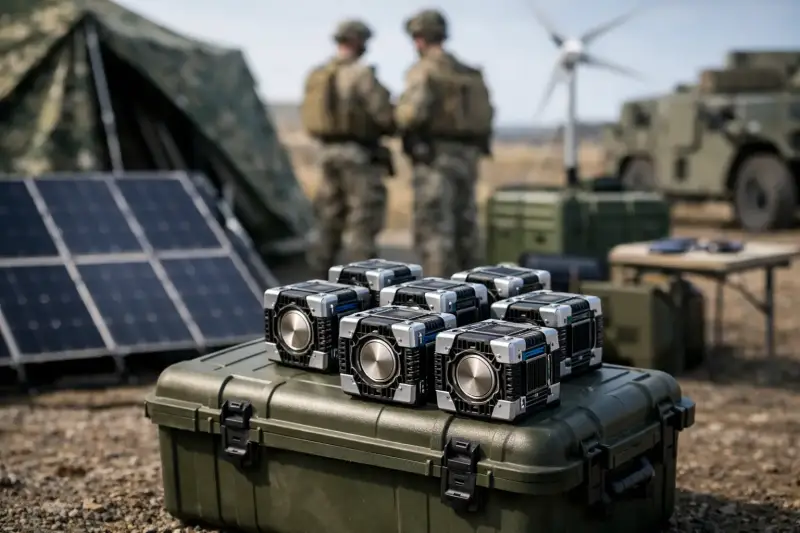
A forward operating base does not fail gracefully when power architecture is poorly chosen. It fails through fuel convoy exposure, thermal signature growth, maintenance drag, degraded communications, and constrained mobility. That is why defense expeditionary energy systems are no longer a support-layer procurement issue. They are a mission architecture issue.
The old model treated field power as a collection of generators, batteries, and tactical workarounds. That approach still appears simple on a spreadsheet, but simplicity at the asset level often produces complexity at the mission level. Every extra liter of fuel, every underloaded genset, every hot-running engine compartment, and every maintenance event compounds logistical risk. In expeditionary operations, inefficiency is not an accounting detail. It becomes exposure.
What defense expeditionary energy systems are actually being asked to do
The requirement set has expanded far beyond basic electricity generation. Modern deployed forces need power for command nodes, sensors, radars, directed energy support loads, communications, water treatment, medical systems, refrigeration, climate control, autonomous platforms, and mobile maintenance operations. In many cases, they also need heating, cooling, hydraulic work, and battery charging from the same deployable footprint.
That changes the engineering target. The best system is not merely the one with the lowest nominal fuel burn at one operating point. It is the one that maintains high conversion efficiency across real duty cycles, tolerates dirty environments, handles load variability without losing control quality, and supports multiple energy outputs without stacking redundant machinery.
This is where architecture matters more than component marketing. A fielded system that couples combustion, mechanical conversion, thermal recovery, storage, and mission loads intelligently can reduce both fuel demand and equipment count. A system that does not will compensate with oversizing, additional trailers, more spare parts, and more operator attention.
Why conventional generator logic breaks down in expeditionary conditions
Most conventional expeditionary power packages inherit the logic of stationary gensets or vehicle-derived engine systems. They are familiar, serviceable, and widely available. But they also carry limitations that become visible under dispersed, irregular, and high-consequence operating conditions.
The first issue is part-load inefficiency. Expeditionary loads rarely stay constant. A system sized for peak communications, transient cooling demand, or surge charging often spends long periods operating far below design load. In a conventional engine-driven generator, that can mean lower fuel efficiency, incomplete combustion behavior, thermal cycling, carbon buildup, and shortened service intervals.
The second issue is parasitic loss. Crankshaft-based systems, accessory drives, cooling loops, and mechanically inherited design conventions consume useful energy before it reaches the mission load. In fixed infrastructure, operators may absorb that penalty. In expeditionary deployment, every parasitic percentage point has downstream effects on fuel volume, heat rejection, acoustic profile, and sustainment burden.
The third issue is integration friction. Electric output alone is often insufficient. Units need usable thermal energy, hydraulic power, and stable charging pathways for storage-backed microgrids. Conventional systems can provide those functions, but often through add-on equipment rather than first-principles design. The result is more interfaces, more failure points, and more packaging inefficiency.
Defense expeditionary energy systems need architectural efficiency, not incremental tuning
Incremental gains matter, but they are not enough when the operating environment punishes waste so directly. A more capable class of defense expeditionary energy systems should start from a different premise: keep the thermal conversion process in its optimal operating region, isolate it from erratic load behavior, and transfer energy into forms that can be dispatched with control precision.
That is a fundamentally different design philosophy from forcing a prime mover to chase every fluctuation in demand. When generation is decoupled from immediate load volatility, the system can be engineered for a stable thermodynamic sweet spot instead of constant compromise. That opens the door to better fuel economy, lower wear, more controllable heat recovery, and improved compatibility with hybrid storage architectures.
For defense buyers, this matters because expeditionary energy is rarely a single-output problem. Electrical power, thermal management, pumping, actuation, mobility support, and storage charging increasingly sit inside the same operational envelope. The question is no longer which generator to ship. The question is which energy core can support the broadest mission profile with the least penalty in logistics and survivability.
Fuel flexibility is no longer optional
Military energy planners know fuel standardization has operational value. They also know the future will not remain locked to one fuel pathway. Diesel remains dominant in many theaters because of supply maturity and field familiarity. Yet the pressure to integrate alternative fuels, synthetic fuels, hydrogen-derived carriers, and lower-signature energy pathways is rising.
That makes fuel flexibility a strategic attribute, not a marketing accessory. An expeditionary system that can maintain high efficiency across current and future fuels reduces transition risk. It also gives planners more room to adapt to theater-specific availability, alliance logistics, emissions constraints at semi-permanent facilities, and future mobile microgrid concepts.
The hard part is doing this without degrading system performance. Many platforms advertise multi-fuel capability, but true operational value depends on combustion control, thermal stability, material compatibility, and power quality under variable environmental conditions. A system that accepts multiple fuels but loses efficiency, response quality, or maintenance life under real deployment conditions has not solved the problem. It has redistributed it.
Thermal signature, noise, and sustainment are linked
Defense energy discussions often separate survivability from efficiency. In practice, they are connected. Poor efficiency creates more reject heat for every unit of useful work. More reject heat drives larger cooling demands, hotter enclosures, and more visible thermal signatures. Likewise, architectures that rely on continuously high-speed mechanical behavior may introduce acoustic penalties that matter in austere or contested environments.
A more efficient energy conversion core can reduce those signatures at the source, although the degree of benefit depends on packaging, duty cycle, shielding, and heat recovery design. This is an area where trade-offs matter. A compact high-output package may improve mobility but intensify thermal density. A larger system with integrated heat utilization may lower waste but complicate rapid deployment. There is no universal optimum. There is only mission fit.
Sustainment follows the same logic. Fewer moving interfaces, lower friction losses, and operation in stable conditions can translate into reduced wear and longer maintenance intervals. That matters because expeditionary maintenance is not performed in ideal workshop conditions. It is performed with constrained spares, limited technician bandwidth, and a low tolerance for unplanned downtime.
The case for hybridized energy cores in the field
The future of deployable military power will likely not be generator-only. It will be hybrid by design. That means pairing efficient primary generation with energy storage, intelligent power electronics, thermal recovery, and load prioritization. The benefit is not ideology. It is control.
A hybridized architecture allows the primary converter to run where it performs best while batteries or other storage absorb transients and support silent watch intervals. Thermal outputs can be captured for shelters, water systems, or process loads instead of being thrown away. Hydraulic pathways can directly serve mechanical work where electric conversion would add unnecessary losses.
This is precisely why new energy architectures deserve serious evaluation. Hydro Puls Systems has argued for a direct-drive, pulse-based, hydraulically centered approach because it addresses a recurring industrial truth: systems gain performance when energy conversion is separated from the mechanical compromises of conventional engine design. In expeditionary defense applications, that principle becomes especially relevant because variable mission loads punish any architecture that cannot hold efficient operating conditions.
What procurement teams should evaluate beyond nameplate output
Nameplate kilowatts remain necessary, but they are not decisive. Technical evaluators should look at full-load and part-load efficiency maps, transient response behavior, maintenance interval assumptions, thermal recovery effectiveness, fuel pathway compatibility, acoustic and thermal signature data, and the amount of auxiliary equipment required to achieve mission-ready functionality.
They should also ask a harder question: does the system architecture scale cleanly from a remote sensor cluster to a forward base microgrid to mobile platform support, or does each use case require a different stack of compromises? Scalable architecture reduces training burden and spare-part complexity. That has procurement value even before fuel savings are counted.
Another point often missed is direct usefulness of output form. If a deployed force needs electricity, heat, cooling support, and hydraulic work, a system engineered to deliver multiple useful outputs from one controlled energy core may outperform a nominally cheaper package built around single-output machines. The lower purchase price can disappear quickly once transport, integration, maintenance, and fuel exposure are modeled honestly.
Defense modernization will reward systems that convert more of every fuel unit into mission effect, with fewer mechanical penalties and greater adaptability to future fuels and hybrid networks. That is the real threshold. Expeditionary power is no longer about keeping the lights on. It is about fielding an energy architecture that keeps operational options open when everything around it is constrained.