

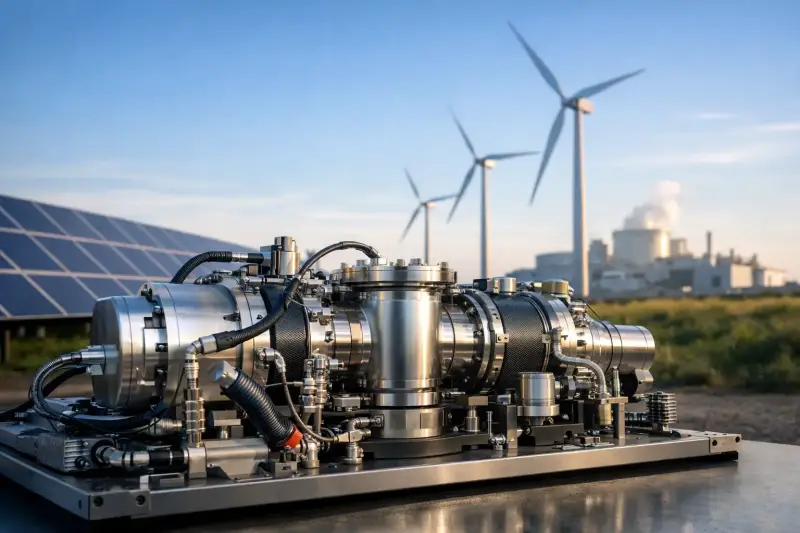
A gas engine specified today may still be on site in 2040. That single procurement fact is why the fuel agnostic power generation system has moved from an interesting concept to a capital allocation issue. Industrial operators, utilities, OEMs, and infrastructure investors are no longer asking only how efficiently a system runs on one fuel. They are asking whether the underlying architecture can survive fuel volatility, emissions regulation, and staged migration toward hydrogen, ammonia, biogas, or synthetic fuels without stranding the asset.
That question immediately exposes a hard truth. Most conventional power platforms are not truly fuel agnostic at the architectural level. They can often be modified for alternative fuels, but modification is not the same as native tolerance. Derating, combustion instability, thermal stress, control complexity, and shortened maintenance intervals often appear the moment the fuel departs from the machine’s original design basis. The commercial language says flexibility. The engineering reality often says compromise.
What a fuel agnostic power generation system really means
A genuine fuel agnostic power generation system is not just an engine with a broader fuel map. It is a power architecture designed to decouple useful energy production from the narrow combustion sensitivities that define conventional crankshaft machines. That distinction matters because fuel changes alter flame speed, ignition behavior, energy density, exhaust composition, knock tendency, storage conditions, and thermal loading. If the prime mover is mechanically and thermodynamically fragile, every new fuel becomes a redesign project.
For industrial buyers, fuel agnosticism has four practical dimensions. First, the system must maintain stable conversion efficiency across multiple fuels, not just remain operable. Second, it must preserve predictable maintenance behavior rather than transferring fuel complexity into service cost. Third, it must integrate with site heat, cooling, hydraulic, or mechanical loads without requiring a complete balance-of-plant rewrite. Fourth, it must provide a credible pathway from current fuels to future low-carbon fuels in staged deployment.
This is why architecture matters more than marketing labels. A machine that can burn hydrogen in a test cell is not automatically a bankable fuel-flexible asset. A power platform becomes strategically relevant when it can accept fuel evolution as an expected operating condition rather than a disruptive exception.
Why conventional systems struggle with fuel flexibility
Conventional reciprocating generation systems were largely optimized around a tightly defined mechanical chain: combustion event, piston motion, crankshaft rotation, generator coupling. That chain works well when operating conditions remain close to the original design envelope. It becomes less elegant when fuel chemistry starts moving.
Hydrogen illustrates the issue clearly. Its high flame speed and low ignition energy can create pre-ignition and control challenges. Ammonia introduces opposite problems, including slower combustion characteristics and more difficult ignition behavior. Biogas can bring variable calorific value and contaminants. Synthetic fuels may improve carbon performance while introducing different storage and handling constraints. In each case, the machine is not simply dealing with a different energy input. It is dealing with a different combustion personality.
The result is often a cascade of engineering concessions. Compression ratio, injection strategy, ignition timing, turbocharging, emissions treatment, materials selection, and control software all move. Efficiency may fall. Reliability margins may narrow. The operator inherits transition risk that was supposed to be solved by the technology.
A fuel agnostic platform should do the opposite. It should absorb fuel diversity while preserving a stable internal operating condition.
The architectural shift behind advanced fuel agnostic power generation systems
The most credible route to fuel flexibility is to separate combustion management from load volatility and from the mechanical losses associated with traditional engine kinematics. Once the system no longer depends on a crankshaft-centered architecture to convert every combustion pulse into useful work, new design freedom appears.
This is the logic behind next-generation isolated combustion and hydraulic transfer approaches, including the type of direct-drive architecture advanced by Hydro Puls Systems. Instead of forcing the prime mover to chase fluctuating electrical or mechanical loads in real time, the energy core can operate in a controlled sweet spot while hydraulic power transfer manages output delivery. That changes the conversation from fuel-specific tuning to system-level thermodynamic control.
For engineering teams, the implications are substantial. Constant-condition operation supports more consistent combustion. Reduced friction paths and lower parasitic losses improve the net efficiency case. Decoupling the energy conversion core from variable load behavior can also simplify integration with CHP, pumping, propulsion, industrial motion, or microgrid stabilization. Most important, fuel changes do not automatically translate into the same magnitude of mechanical penalty seen in legacy layouts.
This does not mean every fuel behaves identically. It means the system is built to manage those differences from a stronger first-principles foundation.
Where the value is created
The market often frames fuel flexibility as a compliance or sustainability benefit. That is too narrow. In industrial settings, the value of a fuel agnostic power generation system is created through optionality, asset longevity, and multi-output efficiency.
Optionality matters because fuel markets do not move in a straight line. A site may begin on natural gas, blend biogas where available, add hydrogen over time, or evaluate ammonia in sectors where storage and logistics support it. A port, greenhouse cluster, defense installation, remote mine, or data center may prioritize resilience before it prioritizes full decarbonization. If the power platform supports staged transition, the owner can make fuel decisions based on economics and infrastructure timing instead of equipment lock-in.
Asset longevity matters because industrial energy equipment is financed over long horizons. The more specialized the machine is to one fuel, the greater the stranded-asset risk under changing emissions policy or supply conditions. A system with real fuel flexibility protects residual value.
Multi-output efficiency matters because electricity is only part of the equation. In CHP, district energy, desalination, greenhouse heating, industrial process heat, and transport propulsion, the winning platform is often the one that can route energy into the most valuable form at the site boundary. If the architecture naturally supports direct hydraulic work, stable thermal capture, and modular power delivery, the project economics improve beyond simple electrical efficiency comparisons.
The trade-offs serious buyers should examine
Not every claim of fuel agnosticism deserves equal weight. The technical diligence should focus on what happens off the brochure.
Start with efficiency retention across fuels. A system that loses meaningful performance when moving from gas to hydrogen-ready operation may still have a role, but it is not delivering full strategic flexibility. Then examine combustion stability and emissions behavior under transient and baseload conditions. Ask whether the machine was designed for isolated, controlled operation or retrofitted for broader fuel acceptance.
Maintenance intervals are equally important. Some platforms tolerate alternative fuels only by increasing inspection frequency, raising parts wear, or tightening operating windows. That shifts savings from fuel or carbon into OPEX. Engineering buyers should also evaluate controls complexity, auxiliary systems, fuel conditioning requirements, and whether output quality remains stable when the site load changes quickly.
There is also a scale question. A technology may perform well in a niche distributed application but struggle in modular plant deployment, transport integration, or mission-critical backup duty. Fuel agnosticism only becomes industrially relevant when it scales with repeatable economics.
Why this matters now, not later
The energy transition is not a single-fuel replacement event. It is a prolonged period of overlapping infrastructures, uneven regulation, regional fuel availability, and project-by-project pragmatism. That is exactly the environment where a fuel agnostic power generation system becomes more valuable than a single-fuel high-efficiency machine.
Industrial buyers need equipment that can produce returns under current fuel realities while preserving a pathway to lower-carbon operation. Investors need platforms that reduce transition risk rather than speculate on one fuel timeline. OEM partners need architectures that can be integrated into power, propulsion, and process systems without redesigning the entire machine stack for each new fuel.
That is why the next competitive boundary is not just better combustion. It is better system architecture. The winners will be the platforms that keep the energy core stable, convert heat to useful work with fewer mechanical penalties, and let fuel strategy evolve without forcing the owner to replace the asset.
For decision-makers building assets meant to operate for decades, the smartest question is no longer whether a machine can run on multiple fuels. It is whether the architecture was built from day one to make fuel change an advantage instead of a liability.