Desalination
HPDD v26: The Direct-Drive Revolution for Industrial Desalination & Fresh Water Security
Pure potable water and valuable technical minerals from the ocean, without grid dependency, toxic brine discharge, or positive production costs.
Global freshwater demand is at an all-time high, yet conventional desalination plants face insurmountable physical and ecological limits. High energy penalties, fragile membranes, and the destructive dumping of hypersaline brine into coastal marine ecosystems make legacy systems unsustainable.
The HPDD platform breaks through these bottlenecks by fundamentally redefining desalination: moving from an ongoing operational cost center to an autonomous, highly profitable resource production model.
Why HPDD v26 Transforms the Desalination Sector
- Zero Grid Dependency (Direct Mechanical Drive):
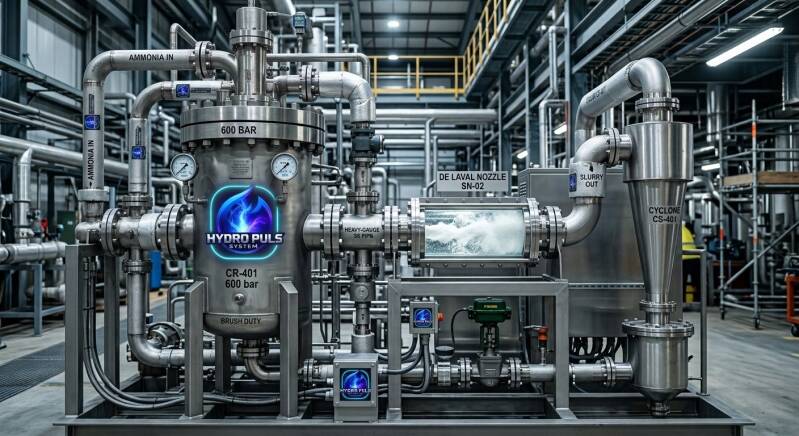
Where conventional plants require massive utility connections and face multi-year grid-congestion delays, HPDD operates directly on green hydrogen or liquid ammonia. Separation fluid pressure is generated directly through linear mechanical conversion, bypassing bulky transformers, external generators, and heavy electric drive motors entirely. - Negative Cost of Water (Negative LCOW):
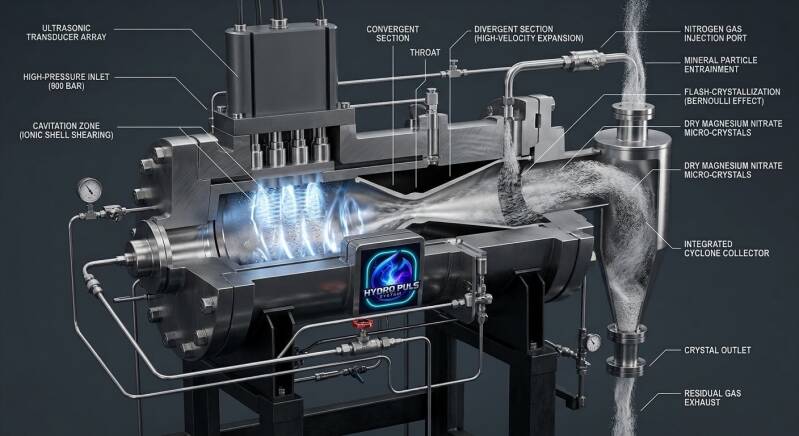
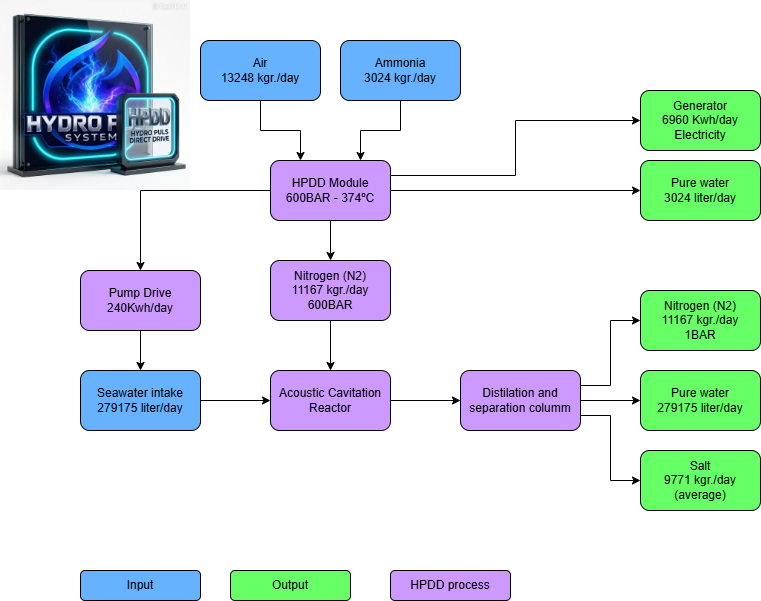
Rather than discarding reject brine as a toxic liability, dissolved minerals are extracted in-line as refined, market-ready technical salts. Commercial revenues from these co-products fully offset facility CAPEX and OPEX, converting fresh water into a zero-cost economic dividend. - True Zero Liquid Discharge (ZLD):
The platform completely eliminates coastal brine dumping. This unlocks large-scale desalination permits in ecologically sensitive marine environments where legacy reverse osmosis outfalls are strictly prohibited. - Dual-Water Harvesting Dynamic:
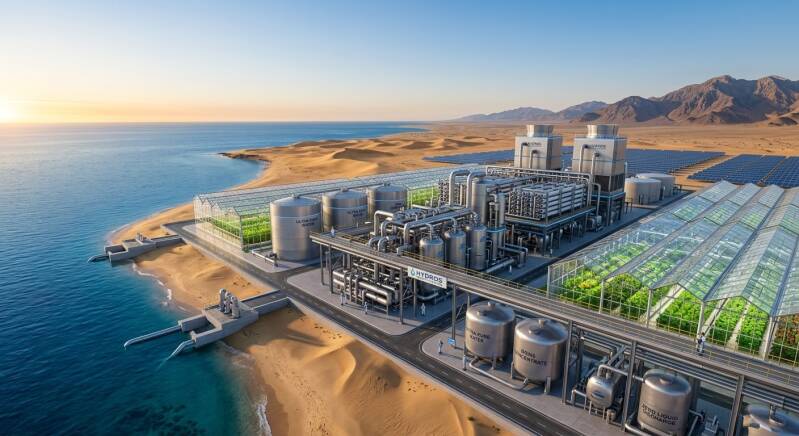
Clean water is harvested across two concurrent streams: high-volume marine desalination and the continuous capture of unpressurized, distilled-quality reaction water from fuel conversion. A single multi-MW facility outputs thousands of liters of certified potable water per hour around the clock. - Elimination of Membranes & Chemical Wash Trains:
Legacy Reverse Osmosis (RO) suffers from persistent bio-fouling, mineral scaling, and frequent membrane element replacements. By driving phase separation through physical and acoustic dynamics, toxic chemical antiscalants and periodic acid flushes are permanently designed out of the operating envelope.
Strategic Autarky for Coastal and Arid Regions
For drought-impacted coastlines, island territories, and large-scale agricultural projects, HPDD v26 delivers complete water sovereignty. Without relying on vulnerable power grids or complex chemical supply chains, the installation provides certified SASO/WHO-grade potable water for municipal grids, industry, and soil restoration—autonomous, clean, and permanently scalable.

Frequently Asked Questions: High-Efficiency Reverse Osmosis
How does the HPDD improve the energy efficiency of desalination?
The largest cost in Reverse Osmosis is the electricity required to drive high-pressure pumps. Traditional pumps lose significant energy through mechanical friction and conversion. The HPDD delivers the required pressure (typically 60–80 bar for seawater) with an electrical-to-hydraulic efficiency of up to 62%. By eliminating the crankshaft and using a frictionless 5-micron gap, we drastically reduce the energy footprint per cubic meter of clean water.
Can the HPDD handle the corrosive nature of seawater?
Seawater is incredibly destructive to standard steel pumps. The HPDD utilizes aerospace-grade Inconel for its core components. Inconel is virtually immune to salt-water corrosion and pitting. Combined with our hermetically sealed architecture, the system’s internals are protected from the harsh environment, ensuring long-term reliability where traditional pumps fail.
What is the advantage of the HPDD’s "Pulse Technology" for membranes?
Traditional RO systems suffer from "fouling" (clogging) of the membranes. The HPDD is a high-frequency transducer. The ultra-fine pressure pulses it generates can be software-tuned to create a "micro-vibration" in the water flow. This helps keep the membranes cleaner for longer periods, reducing the frequency of expensive chemical cleaning cycles and extending membrane life.
How does the maintenance-free claim benefit remote coastal areas?
Many desalination plants are in remote or arid regions where specialized technicians are scarce. The HPDD offers a 20,000+ hour maintenance-free interval. With no oil to change, no mechanical seals to replace, and no belts to monitor, the system provides a "set-and-forget" solution that is ideal for decentralized water production in isolated communities.
Can the HPDD scale for large municipal water plants?
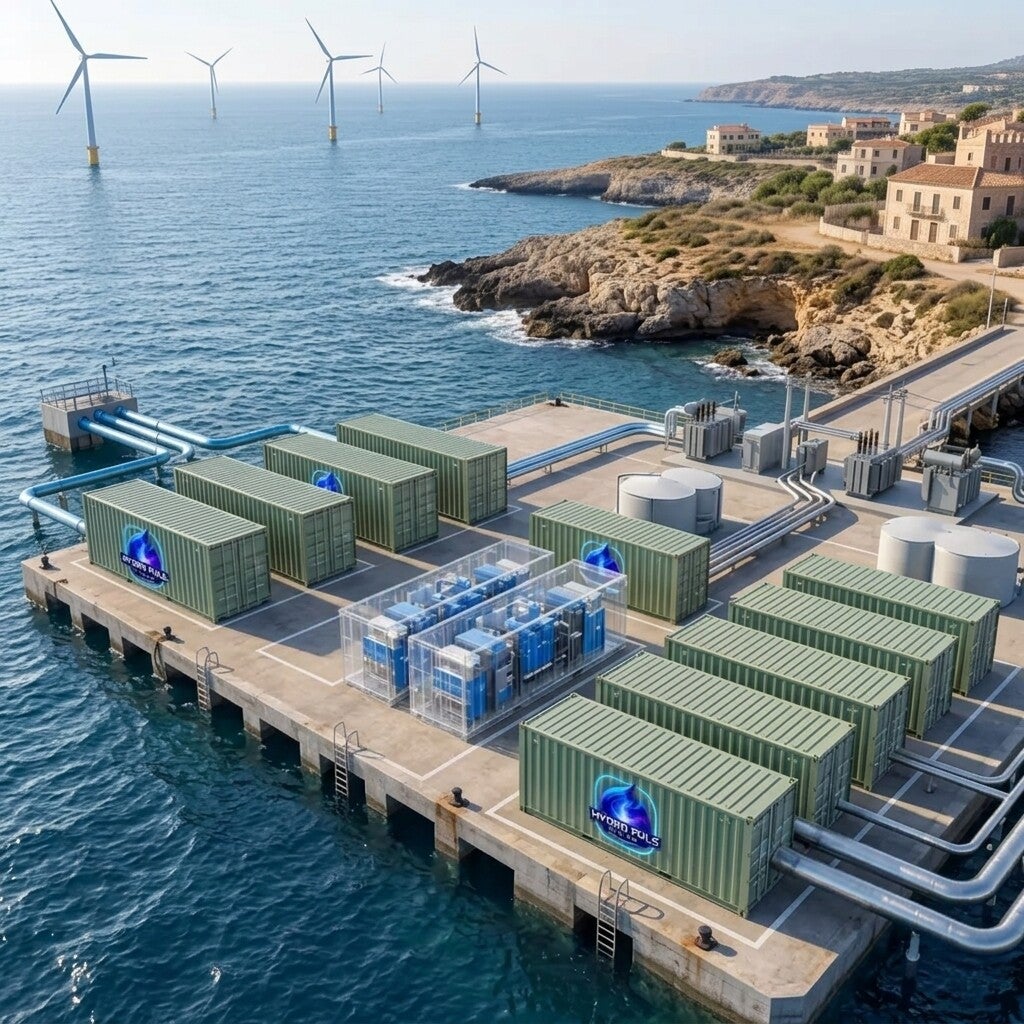
Yes. Through our Modular Swarm Architecture, we can deploy hundreds of HPDD modules in parallel within a single facility. This provides massive scalability and, more importantly, unparalleled redundancy. If one module requires inspection, the plant continues to produce water at near-full capacity, eliminating the risk of a total city-wide water shutdown.
Is the system compatible with renewable energy sources?
The HPDD is the perfect partner for solar and wind-powered desalination. Because it is a software-defined system, it can instantly adjust its output to match the available energy from renewable sources. When the sun shines or the wind blows, the HPDD ramps up production; when energy is low, it scales back seamlessly without the "startup wear" that damages traditional mechanical pumps.