

BESS
Beyond the Battery Illusion: Why the Era of Large-Scale BESS is Over
The global energy sector is locked in a massive capital race to deploy multi-megawatt Battery Energy Storage Systems (BESS). Driven by high renewable penetration and grid instability, operators are spending billions bolting chemical battery containers to concrete slabs.
But the industry is missing a critical truth: BESS is an expensive, inefficient band-aid for a structural design flaw.
We don't need to store energy shortages and oversupplies. We need an energy source that can modulate. The Hydro Puls Direct-Drive (HPDD) platform addresses grid volatility directly at the source, rendering traditional chemical battery parks entirely obsolete.
The Hidden Capital and Operational Liabilities of BESS
Traditional power grids rely on massive, rigid power plants that are slow to ramp up or down. When regional demand drops or solar/wind production spikes, these assets cannot cope. They are forced to dump excess energy at negative prices or pay heavy curtailment penalties.
BESS was introduced to capture this wasted energy and dispatch it during shortages. However, treating the symptom rather than the cause introduces severe operational and financial liabilities for technical buyers and infrastructure developers:
- Massive Parasitic Power Drain: Lithium-ion cells are highly sensitive to thermal gradients. To prevent catastrophic failure, a standard BESS must constantly run heavy HVAC or liquid-cooling infrastructure. This "vampire load" continually drains grid electricity just to keep the battery safe.
- The Threat of Thermal Runaway: Under operational abuse, manufacturing defects, or ambient temperature swings, chemical batteries risk thermal runaway—a self-sustaining, uncontrollable exothermic reaction that spreads from cell to cell, leading to severe fires and toxic gas emissions.
- Accelerated Degradation and Stranded Energy: As individual cells operate at slightly different temperatures within a module, they degrade unevenly. This creates internal resistance mismatches and triggers early voltage cutoffs. The result is "stranded energy"—usable capacity trapped inside the battery that cannot be accessed, causing performance to fall below financial models.
- The Arbitrage Trap: The financial return on investment (ROI) for a BESS relies almost entirely on market volatility (buying energy cheap and selling it high). As soon as grid flexibility stabilizes, these artificial price swings flatten, and the economic business case for battery arbitrage dries up.
The HPDD Disruption: Dynamic Source Modulation
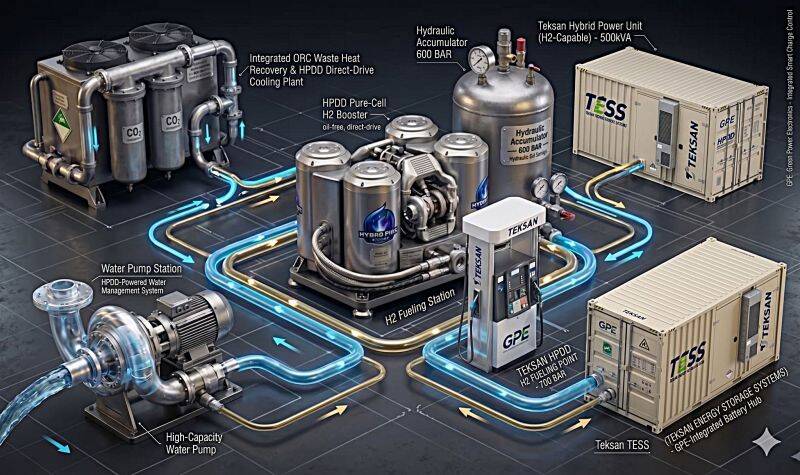
The HPDD platform replaces chemical energy storage with a highly synchronized, software-defined modular container swarm that adapts to the grid in real-time. By utilizing a breakthrough crankshaft-less layout, the platform divides the power path into two independent regimes via an advanced hydraulic intermediary.
| Regime | Component / Mechanisme | Functie & Gedrag |
|---|---|---|
| Combustion Core | Verbrandingscilinders | Draait continu op één vast, optimaal en ultra-efficiënt thermodynamisch punt (Fixed Optimal). |
| Hydraulic Buffering | 600-Bar Accumulatoren | Vangt 100% van de volatiele, milliseconde-tot-milliseconde netmodulatie en schokken op (Instant Modulation). |
| Output Delivery | Direct Power & Cooling (De Laval loops) | Levert dynamische stroom, net-positieve waterproductie en -25°C koeling op basis van de actuele marktvraag (Dynamic Swarm). |
1. The Excavator Principle (Mechanical Precision)
In a conventional engine, the combustion core must directly chase every transient spike and drop in the load profile, ruining efficiency and accelerating wear. The HPDD architecture operates like an industrial excavator. The core verbrandingscilinders run continuously at a single, fixed, ultra-efficient thermodynamic sweet spot.
The hydraulic circuit and our 600-bar hydraulic accumulators handle 100% of the volatile, millisecond-by-millisecond grid modulation. Hydraulics absorb the mechanical shocks, allowing the energy core to remain perfectly stable.
2. Digital Swarm Throttling
Instead of one overdimensioned utility asset, a large-scale HPDD deployment consists of multiple standardized containers. When regional power or data center demand drops, individual containers simply drop offline. The remaining active units continue to run at peak efficiency. When a demand spike occurs, the 600-bar accumulators instantly bridge the initial milliseconds while the standby units spool up frictionlessly.
You scale generation to match consumption live. No excess energy is created, so no battery storage is required.
3. From Power Penalty to Multi-Output Dividends
While a conventional BESS drains vast amounts of electricity to cool itself, the HPDD v26 turns extreme expansion physics into an asset. Via integrated De Laval exergy loops, it co-generates industrial sub-zero immersion cooling down to -25C at a parasitic load of exact 0.0 kW.
Simultaneously, by shock-condensing the clean fuel exhaust (operating on green ammonia, NH_3, or hydrogen), an HPDD swarm actively harvests thousands of liters of pure, technical-grade freshwater per hour.
Retrofitting the Future: A Seamless Infrastructure Upgrade
Transitioning away from the high CAPEX of battery parks does not require decommissioning existing power assets. Legacy grid operators can implement an HPDD "swarm shell" directly on-site:
-
Baseline Stabilization: The existing, rigid power plant is dialed back to run at a stable, slightly lower baseline capacity ($80\%$), where it achieves its maximum theoretical efficiency without mechanical stress.
-
Active Hydraulic Buffering: A modular swarm of HPDD containers is installed alongside the main plant. These plug-and-play units continuously modulate, instantly soaking up grid peaks and filling the valleys.
This hybrid approach stops price volatility at the distribution node. By fixing the inflexibility of the prime mover, the artificial price swings that battery parks rely on are flattened out of existence.
Legally Fortified Global Security
To provide institutional investors, infrastructure developers, and utility operators with absolute structural and intellectual certainty, this closed-loop modular architecture is backed by an ironclad global moat. The platform is supported by 42 filed patents, with our PCT application currently entering the international phase across 157 countries.
The energy transition does not need more expensive chemical battery pleisters. It needs a flexible, responsive, and net-positive source.