

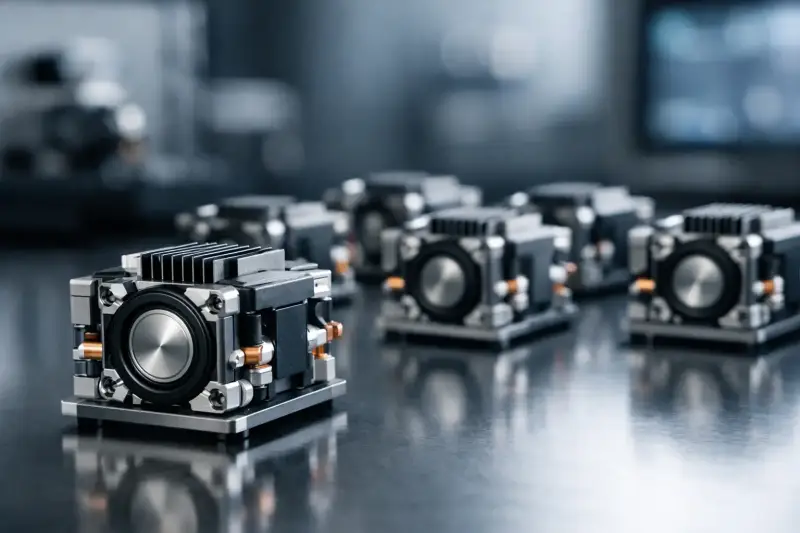
Why do conventional engines waste so much fuel?
Because we ask them to do two incompatible jobs at once: generate power and chase a wildly changing load.
Every time a traditional engine throttles, shifts speed, or operates under partial load, its efficiency plummets. It’s a century-old mechanical compromise.
This is why **Thermal Transformers** represent a paradigm shift for industrial energy.
Unlike standard machines, a true thermal transformer treats heat conversion as an isolated, highly controlled process. By decoupling the thermal core from the external load, we eliminate the transient penalties that undermine legacy engines.
Here is why this architecture changes the math for industrial operators:
⚡ **Load Decoupling**
Instead of constantly wandering through low-efficiency states, the thermal core remains locked in its thermodynamic sweet spot. The output side dynamically buffers, modulates, or redirects energy to match real-world demand without disturbing combustion.
🔥 **Stable Combustion & Constant-State Operation**
Thermodynamics rewards stability. When you isolate the thermal zone from rotational kinematics, you gain precise control over pressure, temperature, and residence time. This is especially vital for fuel flexibility—allowing seamless transitions between natural gas, hydrogen, or green ammonia.
⚙️ **Radically Lower Mechanical Losses**
By removing crankshafts and complex linkages, you eliminate side-loading friction. For instance, the **Hydro Puls Direct-Drive** utilizes opposing piston pairs hovering on a frictionless gas cushion, keeping a precise 5-micron running gap perfectly stable even under 230°C thermal expansion.
🔄 **Integrated Multi-Output (Quad-Generation)**
Industrial sites don't just need electricity. They need heat, cooling, and process water. A thermal transformer is engineered from day one as an integrated core, delivering power, high-grade heat (via a safe, unpressurized siloxane loop), absorption cooling, and atmospheric drinking water simultaneously.
The next decade of the energy transition won't be won by chasing marginal gains on legacy drivetrains. It will be won by refusing bad architecture from the start.
At industrial, utility, or marine scale, nameplate efficiency is just a brochure number. Real-world, constant-state system usefulness is what drives actual project economics.
Curious about how a grid-independent thermal transformer can future-proof your industrial assets? Let’s connect.
#EnergyTransition #ThermalTransformer #Decarbonization #HydroPulsDirectDrive #IndustrialEnergy #Engineering #PowerGeneration
.