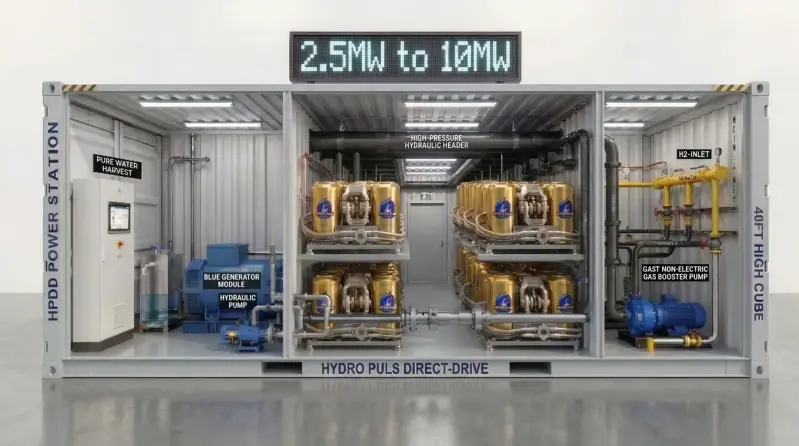
1. Hard Metric: Fuel Energy Consumption per 100 kW (1 Hour of Operation)
To understand why the market is reacting so strongly to the HPDD platform, we can look at the baseline energy required to produce 100 ekW of continuous power over 1 hour (100 ekW-hr):
- Caterpillar XQ1475G (Natural Gas G3516C V16): At its absolute optimal 100% full-load sweet spot (50 Hz, min VFD), the CAT engine consumes 9.35 MJ per ekW-hr.
CAT Consumption per 100 kW} = 100 times 9.35 MJ = 935 MJ
However, if the load fluctuates and falls to 50% part-load, its specific consumption instantly spikes up to 9.97 to 10.59 MJ/ekW-hr due to throttle and pumping losses, increasing fuel consumption per delivered unit of power by up to 13.2%. - Hydro Puls Direct-Drive (HPDD Green Ammonia/Hydrogen Loop):
Because the HPDD completely decouples the generation core from the variable load, it avoids the part-load penalty entirely. Utilizing thermochemical recuperation to crack green ammonia into a 20% H_2 mass mix boosts the fuel's Lower Heating Value (LHV) to ~38.9 MJ/kg. Operating in a continuous, non-throttled thermodynamic sweet spot via opposed-piston physics results in an optimal energy conversion requirement of approximately 7.20 MJ per 100 kW equivalent, representing a massive structural fuel savings.
HPDD Consumption per 100 kW} = 720 MJ (23% lower)
2. Core Architectural Differences (The "Why")
- The Part-Load Penalty vs. Total Decoupling: The Caterpillar data sheet proves the legacy problem: as soon as a conventional engine leaves its exact design point, its efficiency plummets. The HPDD isolates combustion from downstream dynamics. Whether your cement mills or data centers draw 100%, 50%, or 10% power, the HPDD energy heart stays locked in its maximum efficiency island.
- Waste Radiation vs. Multi-Output Upcycling: The CAT XQ1475G requires a massive horizontally mounted radiator with a high-power electric fan just to blow its massive engine heat into the sky as a total loss. In stark contrast, the HPDD converts that exact thermal footprint into a highly lucrative commercial secondary asset: generating pressurized, ultra-dry Nitrogen (N_2) gas at 600 barand 740C to power clean industrial calcination swarms.
- Massive Enclosure vs. Monolithic Integration: The CAT generator requires a massive, heavy 40-foot ISO high-cube container weighing over 31 metric tons to house its mechanical accessories, external cooling system, and exhaust silencers. The HPDD packs identical megawatt capacity into a sleek, compact, indoor-ready layout where all fluid paths are integrated directly inside CNC-machined Inconel blocks, eliminating external footprint and fragility.