

A conventional engine tied directly to a variable load spends too much of its life away from its best operating point. That single fact explains why does load decoupling matter in serious energy engineering: when generation is forced to chase every fluctuation in torque, speed, or demand, efficiency falls, thermal conditions drift, emissions control gets harder, and mechanical stress rises.
For industrial operators, utilities, OEMs, and project developers, this is not a small design preference. It is an architectural question. Do you build a system where the prime mover is constantly disturbed by the load, or do you build one where energy is generated in a controlled zone and transferred to the work process in a form the application can actually use?
Why does load decoupling matter in real systems?
Load decoupling matters because real loads are unstable. Pumps ramp. Compressors cycle. Propulsion systems see transient demand. Microgrids swing between charging, process heat, and electric output. A conventional mechanically coupled machine has to follow all of that behavior in real time. The result is part-load operation, speed variation, throttle losses, combustion instability, and poor use of installed capacity.
The thermodynamic penalty is familiar to any engineer who has looked at brake-specific fuel consumption maps. Most machines have a narrow island where fuel conversion is strongest and losses are lowest. Outside that island, friction consumes a larger share of output, combustion quality degrades, and heat rejection rises. If the machine is hard-coupled to the load, it cannot stay in that island for long.
Decoupling changes the logic. Instead of forcing the energy core to mirror every downstream fluctuation, the system isolates generation from demand variation and uses an intermediary architecture - hydraulic, electrical, pneumatic, thermal, or hybrid - to shape output at the point of use. That is how a machine can remain in its engineered sweet spot while the application still receives variable power.
This is one reason advanced direct-drive hydraulic architectures are gaining attention. They are not trying to make an old engine marginally better. They are changing the relationship between combustion, conversion, storage, and work.
The physics behind why load decoupling matters
At first-principles level, a prime mover performs best when pressure development, temperature profile, flow behavior, and moving mass are kept within controlled bounds. Variable load disturbs all four.
When torque demand spikes in a directly coupled machine, the system responds by changing fueling, air handling, timing, speed, or all of them together. That creates transient inefficiency. Air-fuel preparation may lag. Pressure rise may shift away from the optimal profile. Rotational systems may move into a less favorable friction regime. Auxiliary systems such as turbocharging, cooling, and aftertreatment can also fall out of sync.
In a decoupled architecture, the energy conversion unit is not required to absorb those disturbances directly. It can run at a fixed or tightly optimized operating condition. The load sees controlled output through the transfer medium. The value of that arrangement is not abstract. It shows up as lower parasitic loss, better repeatability, narrower thermal excursions, and more predictable system control.
That predictability matters even more when fuel flexibility enters the picture. Systems designed to operate across diesel, gas, hydrogen blends, ammonia-derived pathways, or future low-carbon fuels benefit from stable chamber conditions. The less the energy core is whipped around by demand swings, the easier it becomes to validate combustion behavior, materials durability, and emissions performance.
Efficiency gains are only part of the story
Many discussions stop at fuel efficiency, but that is too narrow. Yes, load decoupling can improve conversion efficiency by keeping the machine near its best pressure and temperature regime. But the larger industrial advantage is often system-level performance.
A decoupled machine can be sized for average optimized generation rather than worst-case instant response. It can buffer transient events without oversizing the thermal core. It can improve quality of delivered power or hydraulic work. It can coordinate heat recovery more effectively because the thermal source is steadier. In combined heat and power, that stability is especially valuable. Recoverable heat becomes more predictable, and predictable heat is easier to monetize.
This also affects maintenance economics. A machine cycling aggressively with the load sees more stress concentration, wider temperature swings, and more variable lubrication conditions. A machine held near steady-state tends to be easier to manage over long intervals. That does not eliminate wear, and no serious engineer should claim it does, but it changes the wear profile in a favorable direction.
For investors and asset owners, that means the question is not only fuel consumed per kilowatt-hour. It is dispatch quality, maintenance burden, useful thermal output, life-cycle cost, and the ability to keep performance inside a bankable range.
Where load decoupling creates the most value
The strongest value appears where demand is dynamic but uptime and efficiency are non-negotiable. Industrial CHP is a prime example. Electrical demand can vary by shift, while thermal demand follows process conditions, weather, or storage strategy. A decoupled system can maintain stable energy conversion and distribute output where the site needs it most.
Transport and marine propulsion are another strong case. Vehicles and vessels rarely operate at one clean design point. They accelerate, idle, maneuver, and cruise. If the power core can remain isolated from those swings, it can operate more efficiently while the drivetrain or hydraulic layer handles variability.
Off-grid and microgrid systems also benefit. In remote operations, fuel logistics dominate economics. Every percentage point of efficiency matters, but so does resilience. Decoupling gives operators another control lever. The generation core can stay stable while storage, pumps, motors, or auxiliary systems absorb fast changes in demand.
Greenhouse systems, desalination, defense power, and industrial pumping all fit the same pattern. The load is not fixed. The mission is not negotiable. Architecture decides whether that variability becomes a penalty or an advantage.
The trade-offs engineers should be honest about
Load decoupling is not magic. It introduces additional components, control logic, and sometimes conversion steps. If done poorly, those layers can add complexity, cost, and new failure modes. A bad decoupling strategy can simply move losses from one part of the system to another.
That is why the transfer medium matters. Electrical decoupling is highly flexible, but it may introduce inverter, storage, and power electronics losses depending on topology. Hydraulic decoupling can be extremely effective for direct industrial work, especially where force density and controllability matter, but hydraulic design quality becomes decisive. Thermal buffering helps in CHP and process applications, though response time can be slower. The right answer depends on duty cycle, required response speed, output form, and maintenance environment.
There is also a scale question. In some small or simple applications, direct coupling remains adequate because the cost of sophistication outweighs the benefit. But as power levels rise, utilization increases, and multi-output integration becomes more valuable, the economics often shift toward decoupled architectures.
For technically literate buyers, this is the real lens: not whether decoupling sounds advanced, but whether it reduces total losses across the full operating envelope.
Why load decoupling matters for next-generation energy platforms
The legacy engine model was built around rotational mechanics and direct mechanical transmission. That model still dominates because it is familiar, not because it is thermodynamically ideal. As energy systems become more modular, multi-fuel, and application-specific, the limits of direct coupling become harder to ignore.
A modern platform has to do more than produce shaft power. It may need to generate electricity, feed hydraulic motion, recover heat, integrate carbon capture, support hydrogen transition, and maintain stable output under variable demand. Those objectives push designers toward architectures where the energy core is autonomous and the load interface is engineered separately.
That is the strategic significance of systems built around isolated combustion and hydraulic energy transfer. The architecture allows the conversion process to remain controlled while industrial work is delivered with far greater flexibility. In that sense, load decoupling is not an accessory feature. It is the foundation for a different class of machine.
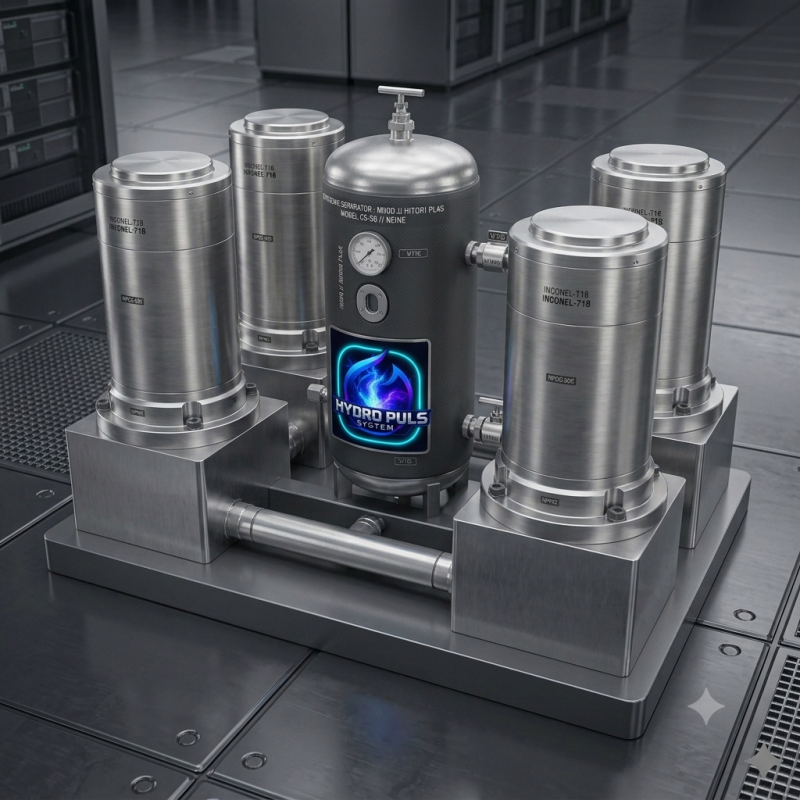
Hydro Puls Systems frames this as an autonomous energy heart, and the phrase fits because the core idea is architectural independence. Once generation no longer has to mechanically obey every fluctuation downstream, the system can be optimized around physics instead of legacy drivetrain constraints.
The most useful way to think about load decoupling is this: it gives engineers permission to separate the conditions required for efficient energy generation from the conditions required by the job. Those are rarely the same. When they are forced into the same machine behavior, compromise follows. When they are separated intelligently, efficiency, controllability, and platform adaptability all move in the right direction.
That is why load decoupling matters, and why more of the future of industrial power will be decided at the architecture level, not at the margin of conventional engine tuning.