CHP plants and mini CHP
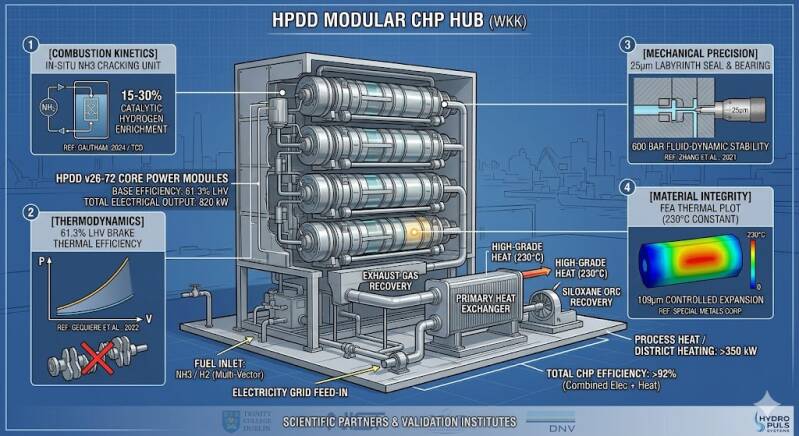
HPDD v26: The Revolution in Decentralized Energy & CHP
Maximize your efficiency, eliminate your emissions. Transition from fossil fuels to 100% Green Ammonia and Hydrogen.
The traditional CHP sector faces a monumental challenge: switching to carbon-free fuels without compromising on reliability and efficiency. The Hydro Puls Direct-Drive (HPDD) is the first machine specifically engineered to fully harness the energy density of ammonia and hydrogen in a maintenance-free, high-frequency platform.
🔋 Why the HPDD v26 is the New Standard for CHP
-
62% Net Efficiency: While traditional combustion engines plateau at 35-45%, the HPDD achieves unprecedented thermal and mechanical efficiency by eliminating the crankshaft and all mechanical friction (5-micron gap).
-
Pure Mono-Fuel (Zero Diesel): Forget complex dual-fuel systems that still require a diesel pilot for ignition. The HPDD utilizes high-frequency plasma ignition and a constant thermal hotspot (230°C Monolith) to achieve stable combustion of pure ammonia.
-
Hermetic Safety for Built Environments: For CHP installations near residential areas or greenhouses, safety is paramount. Our patented Inconel bellows guarantee a 100% leak-proof seal. Ammonia slip into the environment is physically impossible due to the hermetic separation.
-
Maintenance-Free Gas-Bearing Technology: No piston rings to wear out, no lubricating oil to contaminate. The piston floats on a 620-bar nitrogen shield. This results in drastically lower operational expenses (OPEX) and a lifespan that exceeds traditional engines by several factors.
🔥 Smart Thermal Integration
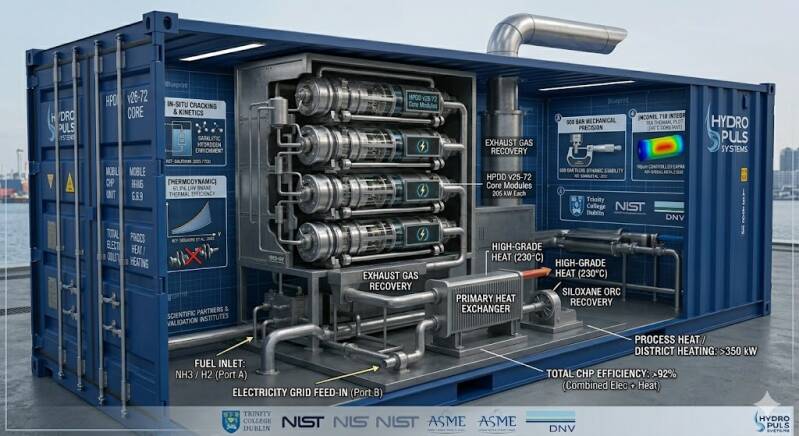
The HPDD is more than just an engine; it is a thermal ecosystem. The residual heat from the Siloxane cooling jacket and the Turbo-Helix is directly recycled for:
-
Fuel Pre-heating: Raising the temperature of incoming ammonia for instantaneous, high-reactivity combustion.
-
ORC Coupling: Feeding an Organic Rankine Cycle for secondary electrical power generation.
-
Direct Heat Supply: Providing high-grade process heat for industrial applications or greenhouse climate control.
📈 Ready for the 1,000-Bar Roadmap
With the capability to scale directly to 1,000-bar hydraulic pressure, the HPDD v26 can drive pumps, presses, or generators with a fraction of the mass and piping required by conventional systems.
The HPDD v26 is not merely a replacement for your current CHP; it is the guarantee that your energy supply is ready for an emission-free future.
Frequently Asked Questions: Combined Heat and Power (CHP)
What makes the HPDD superior to traditional gas engines for CHP?
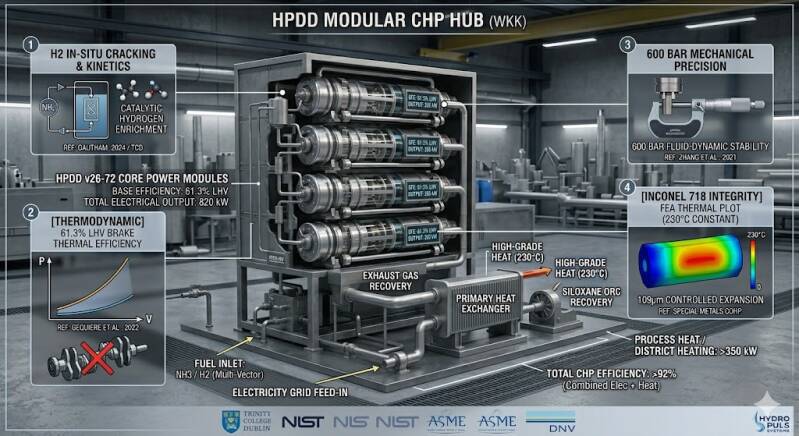
Traditional CHP units (Internal Combustion Engines) are limited by mechanical friction and complex cooling requirements, often peaking at 35-40% electrical efficiency. The HPDD reaches an electrical efficiency of up to 62%. Because it operates at a stable 230°C, the "waste heat" is of much higher quality, making it easier to recover for industrial processes or district heating.
Can the HPDD CHP system run on carbon-free fuels?
Absolutely. The HPDD is optimized for Green Hydrogen and Ammonia (NH3). This allows businesses and local grids to generate both heat and power with zero CO2 emissions. It transforms the CHP from a transition technology into a permanent, sustainable energy solution.
How does the system handle "Variable Demand" in heat and power?
Most CHP units must run at full load to be efficient. The HPDD is a software-defined transducer; it can modulate its frequency and output in real-time without losing efficiency. Whether you need maximum heat in the winter or maximum power for industrial cooling in the summer, the HPDD adjusts instantly to your thermal and electrical load.
What is the maintenance interval for a 24/7 CHP operation?
Maintenance is the "silent killer" of CHP profitability. Traditional engines require frequent oil changes and spark plug replacements. The HPDD has no oil system, no crankshaft, and zero friction parts, leading to a 20,000+ hour maintenance-free interval. This ensures maximum uptime and a significantly faster Return on Investment (ROI).
Is the HPDD quiet enough for installation in residential buildings?
Yes. Traditional CHP units require massive acoustic enclosures to dampen the low-frequency vibrations of the engine block. The HPDD operates as a high-frequency solid-state device, eliminating heavy mechanical clatter. This allows for more compact installations in basements or rooftop mechanical rooms with minimal noise insulation.
How does the "Zero-Friction" design impact the system's longevity?
CHP systems often run for 8,000 hours per year. In a traditional engine, this leads to rapid wear. The HPDD uses a 5-micron air-gap principle and Inconel components that expand uniformly at 230°C. This means there is no metal-on-metal contact, ensuring the system maintains its "as-new" efficiency for decades of continuous operation.