

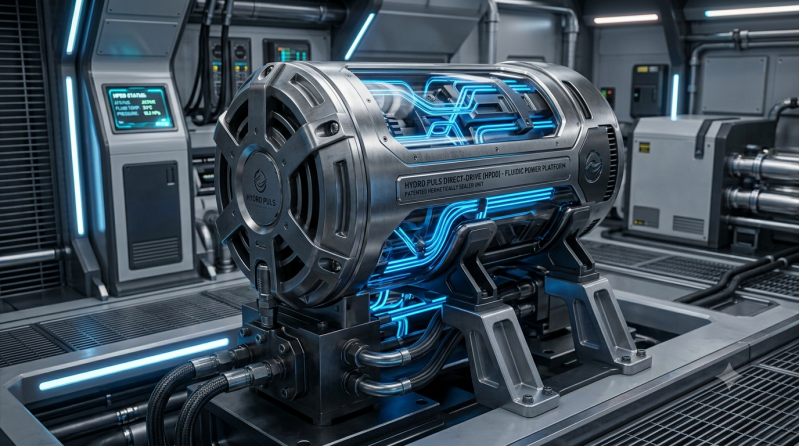
A question that repeatedly surfaces in our discussions with marine engineers, plant operators, and industrial investors:
"Why does the Hydro Puls Direct-Drive (HPDD) platform require zero external engine cooling or make-up water, and why is there literally no exhaust pipe?"
For anyone accustomed to internal combustion engines or steam loops, this sounds counterintuitive. A conventional prime mover dumps over half of its fuel energy into radiators, cooling water circuits, and hot exhaust stacks.
HPDD eliminates this parasitic infrastructure through an entirely different thermodynamic architecture:
1. Zero Exhaust: Strictly Hermetic Closed Loop (ΔMass = 0.000 kg)
HPDD is not an open combustion engine venting gas to the atmosphere. It operates as a fully sealed fluidic cycle. Working species (ammonia, hydrogen, and nitrogen) remain permanently contained, reacting, expanding, condensing, and recirculating internally. No exhaust stack means zero emissions and zero working-fluid loss.
2. Zero Make-Up Water: Endogenous Process Chemistry
Traditional marine and industrial engines consume external fresh water or reject millions of liters of cooling water overboard. In HPDD, high-purity water is generated endogenously at the molecular level as an internal reaction product. This water is captured within the hermetic boundary, recirculated, and utilized as a working hydraulic vector and dynamic fluid cushion. Not a single drop of external water is required.
3. Zero External Cooling: In-Situ Latent Heat Sinks
Conventional blocks overheat due to mechanical boundary friction and unrestrained thermal losses, demanding heavy radiators or sea-chest heat exchangers. HPDD rethinks this balance:
- No solid-to-solid piston-bore friction: dynamic components ride on fluid boundary layers and gas-cushion suspension.
- Phase-change cooling: ammonia possesses an exceptional latent heat of vaporization. Expanding and cycling within the reaction boundaries, the working fluid itself acts as an immediate, internal thermodynamic cold sink directly where energy transformation occurs.
Process heat is not rejected to the environment as parasitic waste; it is captured, balanced internally, and converted directly into high-pressure fluid power up to 600 bar.
The result is an ultra-compact, completely autonomous fluidic power source with no sea valves, no radiators, and no exhaust stacks.
#HydroPulsDirectDrive #HPDD #CleanTech #Thermodynamics #ProcessEngineering #ZeroEmissions #GreenAmmonia #Decarbonization #Fluidics #IndustrialInnovation