

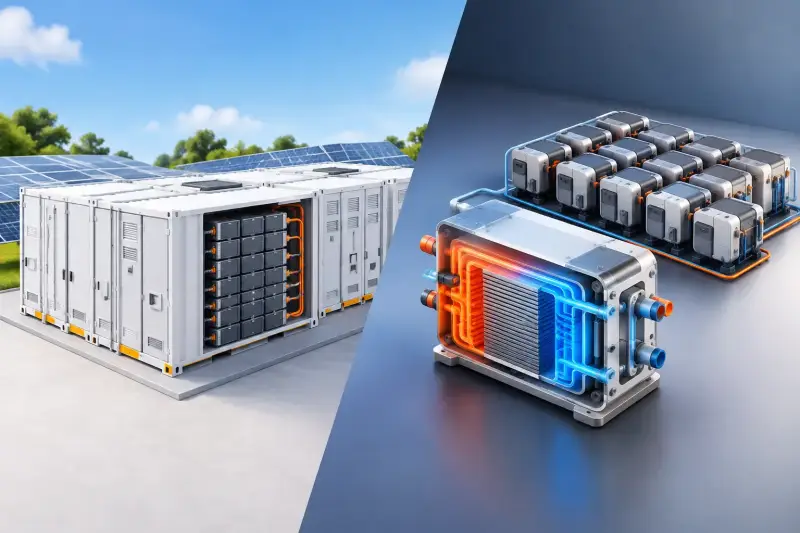
Battery Storage Versus Thermal Transformers.
A data center cannot defer a cooling load because a battery is depleted; a cement plant cannot pause a kiln during an extended peak.
The real question is clear: is the facility seeking finite electricity storage, or a stable energy core continuously converting fuel into electrical, thermal, cooling, and hydraulic power?
Different Jobs
Battery Energy Storage Systems (BESS) store grid power and return electricity later. They excel at millisecond response, frequency regulation, and short peak shaving.
However, batteries generate no net energy and their discharge duration is strictly constrained by installed capacity. Extending output from 2 to 8 hours demands significantly more cells, containers, thermal management, and fire safety systems.
A thermal transformer addresses a fundamentally different challenge.
It decouples energy conversion from variable demand, operating continuously near its thermodynamic sweet spot.
Downstream electrical, hydraulic, heating, and cooling loads are managed independently, replacing the assumption that industrial resilience requires standalone generators, separate boilers, chillers, and ever-larger BESS parks.
Duration and Energy Source
BESS cannot independently sustain multi-day operations through prolonged grid outages.
A fuel-fed thermal transformer operates continuously as long as fuel is supplied, ensuring true operational autonomy for data centers, remote infrastructure, and continuous manufacturing.
It also provides a seamless transition toward hydrogen and ammonia without requiring massive grid connection upgrades.
System Efficiency Over Millisecond Speed
BESS wins on sub-second electrical response, but industrial continuity requires hours or days of uninterrupted output.
Hybrid architectures often deliver the best result: a compact BESS absorbs instantaneous switching and transients, while the thermal transformer supplies baseload, heat, and hydraulic force.
Moreover, efficiency must reflect total useful energy delivered. When a facility demands power, process heat, chilled water, and pumping pressure simultaneously, overall fuel utilization is what matters.
The Hydro Puls Direct-Drive architecture utilizes an isolated combustion chamber and direct hydraulic transfer to eliminate crankshaft friction and redundant electrical conversion steps, functioning as an integrated Autonomous Energy Heart.
Design Around the Load
Evaluating economics requires looking beyond battery CAPEX versus engine CAPEX to the total lifecycle cost of all avoided auxiliary equipment. Batteries are ideal for short-duration electrical timing;
thermal transformers are essential where continuous, multi-energy production and high reliability are non-negotiable. Design around the complete load profile, not the product category.