

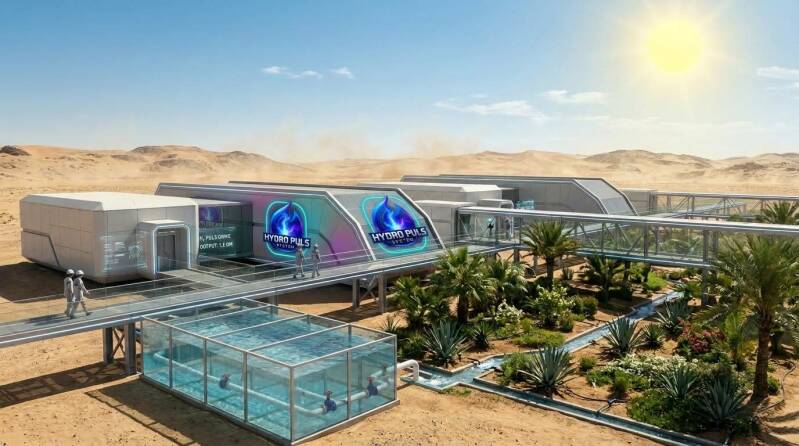
Summer heat waves, prolonged droughts, and critically low river levels are increasingly forcing conventional power stations into the same operational trap: curtailing output or shutting down entirely because cooling water is unavailable or river discharge temperatures exceed legal environmental thresholds.
The core vulnerability of traditional thermal generation is its massive, rigid water dependency. The Hydro Puls Direct-Drive (HPDD) architecture breaks this paradigm completely:
- Zero External Cooling Water Required: Engineered with a hermetically sealed, decoupled fluidic loop (), HPDD does not rely on river intakes, giant cooling towers, or massive evaporative heat sinks to maintain full load during extreme heat.
- Net Water Producer, Not a Consumer: Instead of withdrawing millions of liters of surface water, the HPDD core condenses and extracts clean process water directly from the clean reaction chemistry of fuels like hydrogen or ammonia carriers. Every megawatt-hour generates high-grade water rather than consuming it.
- Uncompromising Grid Reliability: While river-constrained thermal and nuclear assets are forced to throttle down precisely when grid demand peaks due to air conditioning loads, HPDD delivers continuous, dispatchable baseload power regardless of seasonal drought or ambient water scarcity.
- Rapid, Modular Deployment: Free from bulky intake channels, environmental discharge permits, and heavy civil cooling works, modular HPDD units can be placed directly at load centers or in arid, water-stressed regions without utility friction.
True energy resilience requires more than zero-emission generation; it demands thermal and climate independence. A power plant that must shut down when temperatures rise is no longer a viable baseload solution. The future belongs to power generation that produces water instead of competing for it.
#EnergyTransition #PowerGeneration #HPDD #WaterScarcity #DroughtResilience #CleanTech #GridReliability #ProcessEngineering #Decarbonization #ThermalPower