

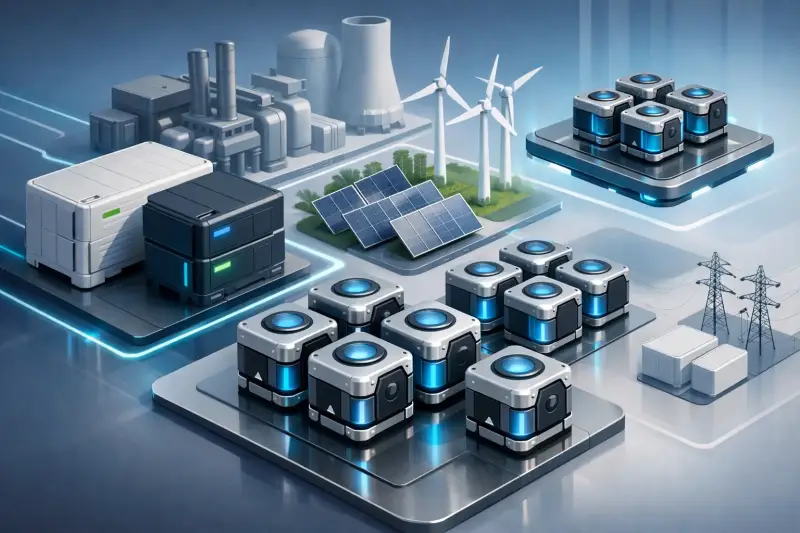
Modular power is no longer just diesel gensets or temporary skids waiting on a grid connection. Today’s industrial requirement demands an integrated energy platform: a system delivering firm electricity alongside process heat, cooling, hydraulic work, water, and carbon-capture energy.
Industrial power succeeds when engineered around real site consumption, not nameplate electrical capacity.
The Grid Is a Variable, Not a Guarantee
Interconnection queues, transmission bottlenecks, and extreme weather mean relying on a single utility feed is an incomplete resilience strategy. Modular power allows sites to run in parallel with the utility, ride through grid disturbances, establish remote energy islands, or stage capacity blocks as production ramps up—drastically de-risking upfront capital deployment.
Dispatchability and Constant-Condition Efficiency
While renewables and batteries excel at short-duration balancing, heavy industry demands sustained dispatchability. The flaw of legacy prime movers is forcing the combustion engine to chase every load swing, triggering severe partial-load and transient losses.
Decoupling energy conversion from load swings solves this. An autonomous core operates continuously at its thermodynamic sweet spot, while variable plant demand is managed externally via storage or fluidic controls.
The Hydro Puls Direct Drive (HPDD) platform embodies this approach: using pulse-based isolated combustion and hydraulic energy transfer to replace crankshaft friction. Where the end-use is pumping, compression, or desalination, direct fluid power eliminates the parasitic losses of converting mechanical rotation to electricity and back to fluid force.
Multi-Output Value Decides the Economics
Evaluating equipment purely on $/MWh misses the bigger picture. Modern developers assess the complete portfolio:
Avoided boiler fuel via process steam and heat recovery.
Displaced refrigeration power via integrated absorption chilling.
High-pressure shaft work delivered directly to process fluidics.
Co-located energy supporting point-source carbon capture and sorbent regeneration.
Future-Proofing Fuel Flexibility
Locking a modular system into a single fuel invites premature obsolescence. Designing for fuel flexibility, from pipeline gas to hydrogen or ammonia—protects assets against shifting regulatory mandates and volatile supply chains.
Modularity is not just a containerized package; it is a full-site operational strategy. Don't look for answers in a generator catalog, start with the thermodynamic profile of your facility.
#ModularPower #IndustrialEnergy #EnergyTransition #HPDD #DirectDrive #Decarbonization #ProcessEngineering #DistributedEnergy #Microgrids #EnergyResilience