

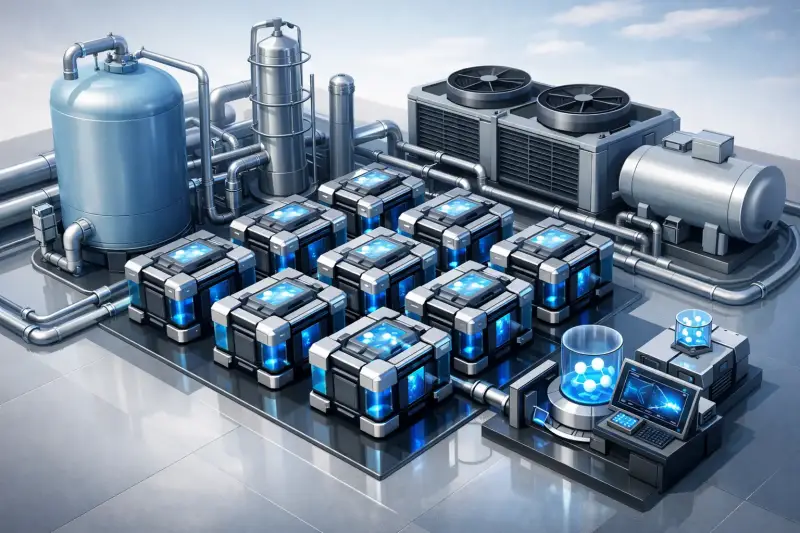
An ammonia generator is not simply a diesel genset with a different fuel tank. Ammonia fundamentally shifts the combustion dynamics, emissions profile, fuel handling, and project economics. Deploying ammonia as a dispatchable industrial fuel requires engineering a complete energy architecture: fuel handling, conversion core, emissions control, thermal recovery, and load integration.
Conversion Pathways:
Direct Combustion: Suitable for high-power demands, but requires flame stabilization (pilot fuels or hydrogen blending) and rigorous NOx abatement.
Cracking to Hydrogen: Decomposes NH3 into H2 and N2 . This implifies the power step in standard H2 -ready equipment, but adds thermal overhead and transient lag.
Electrochemical (Fuel Cells): Delivers high electrical efficiency and minimal local pollutants for steady baseload, offset by higher CapEx and strict fuel purity limits.
Pulse-Based Conversion (HPDD): The Hydro Puls Direct-Drive (HPDD) architecture decouples the combustion event from traditional crankshaft mechanics. By transferring energy hydraulically, HPDD operates as a thermal transformer, maintaining high-efficiency combustion independent of variable electrical or mechanical load swings.
Critical Design Decisions
Start with the Load: Match architecture to actual plant demands (grid-forming, baseload, black-start). Maximize total useful energy by recovering high- and low-grade heat, cooling, or direct hydraulic work.
Toxicity and Handling: Safety drives the layout. High-integrity containment, fast leak detection, active mitigation, emergency isolation, and strict fuel purity standards are mandatory.
Emissions Strategy: Carbon-free combustion can still yield NOx, N2O, and ammonia slip. Abatement systems must be co-engineered with the core and validated across startup, low loads, and dynamic ramps.
Measure Useful Output: Evaluate cost per unit of total delivered energy (power, heat, shaft power) rather than isolated nameplate electrical efficiency, fully factoring in parasitic loads like cracking and exhaust treatment.
Modular Deployment
Validate fuel dynamics, emissions compliance, and service intervals on a single load module before scaling fleet capacity. Modular architectures de-risk capital and establish ammonia as a controllable, reliable industrial energy carrier.
#Ammonia #HPDD #HydroPulsDirectDrive #CleanEnergy #Decarbonization #PowerGen #Hydrogen #IndustrialEnergy #EnergyTransition