

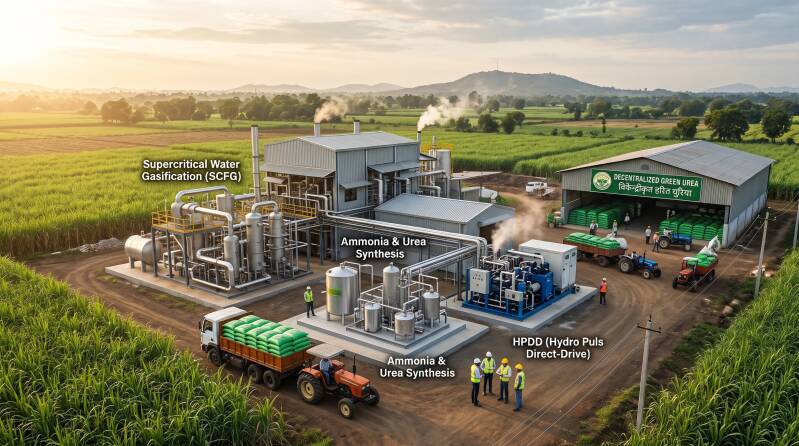
India’s Path to Fertilizer & Energy Sovereignty: Why Decentralized Urea Production is the Strategic Key
India imports millions of tons of urea annually and relies heavily on expensive imported LNG to supply its domestic fertilizer production. At the same time, hundreds of sugar mills and ethanol distilleries face a persistent, high-volume environmental liability: wet organic effluents, notably spent wash (vinasse) and pressmud.
Conventional industry consensus insists that urea synthesis is economically viable only at massive scales (600 to 1,000+ tons per day). Yet evaluating the mass balance and exergy behind the plant gate reveals an entirely different picture.
The Numbers: Turning an Effluent Liability into 150+ TPD Merchantable Urea
A standard 100 klpd grain- or molasses-based ethanol distillery produces ~1,100 m³ of spent wash daily at ~8% organic solids. Blending this stream with pressmud and sugarcane trash raises the dry organic fraction to ~15%:
• Direct Hydrogen & Syngas: Supercritical Water Gasification (SCFG) converts this wet stream into over 32 tons of green hydrogen per day without requiring energy-intensive pre-drying.
• On-Site Ammonia Synthesis: Yields ~180 tons of ammonia (NH3) per day.
• Closing the Biogenic Carbon Balance: Rather than venting fermentation CO2 into the atmosphere, the process fixes biogenic carbon directly on site to form solid urea prills.
Eliminating the Parasitic Grid Penalty: The Role of HPDD
The historic barrier to small-scale chemical synthesis has always been balance-of-plant parasitic loads, principally the electrical and thermal demands of compressors, pumps, and stripping loops.
Rerouting a fraction of the generated ammonia (12 to 16 tons per day) through a Hydro Puls Direct-Drive (HPDD) unit makes the entire facility self-sustaining:
1. Direct Power Generation: Operating at high thermal efficiency (>50%), HPDD converts fluid enthalpy directly into hydraulic and electrical power (~2.5 to 3.0 MW continuous), bypassing overloaded rural transmission lines and grid interconnection delays.
2. Integrated Thermal Coupling: Operating at 230°C, the core rejects high-grade thermal energy directly into the urea decomposers and strippers, eliminating the capital and operational expense of an auxiliary boiler.
The result is a net surplus of 150 to 200+ tons per day of high-grade urea, produced locally against negative feedstock costs.
Strategic Impact for India
• National Import Substitution: Directly cuts foreign exchange expenditure on imported urea and reduces the fertilizer sector's structural exposure to imported LNG volatility.
• Reallocating Gas to Transport: Displaced LNG can be channeled directly to domestic heavy transport and logistics corridors, substituting imported diesel.
• Empowering Rural Agritech: Transforms agricultural cooperatives and distilleries from waste-disposal liabilities into profitable regional polygeneration hubs producing power, steam, and fertilizer.
Real industrial decarbonization does not depend on waiting years for centralized mega-infrastructure. It is achieved by closing the mass and exergy balances inside the plant fence today.
#IndiaEnergy #AgriTech #Fertilizer #CircularEconomy #ProcessEngineering #Decarbonization #HPDD #Urea #Bioenergy