

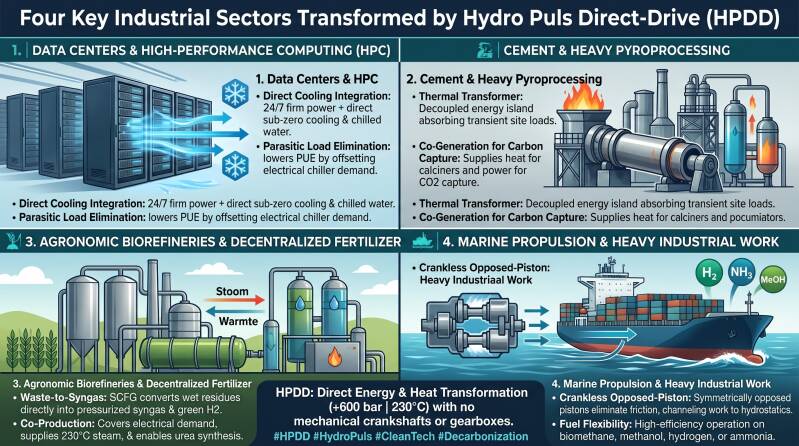
Four Key Industrial Sectors Transformed by Hydro Puls Direct-Drive (HPDD)
Industrial decarbonization requires more than traditional electrification or simply replacing burners. Modern energy-intensive facilities face mounting bottlenecks around grid congestion, heavy parasitic conversion losses, and complex concurrent cooling or thermal demands.
By converting reaction enthalpy directly into high-pressure fluid power (+600 bar) and process heat (230°C) without mechanical crankshafts or gearboxes, the Hydro Puls Direct-Drive (HPDD) architecture establishes an autonomous polygeneration platform behind the meter.
Here are the four primary applications where this integrated architecture delivers decisive advantages:
1. #Data Centers & High-Performance Computing (HPC)
Hyperscalers face multi-year transmission queue delays while consuming up to 40% of their total site power strictly on mechanical chillers and HVAC compressors.
• Direct Cooling Integration: HPDD delivers 24/7 firm baseload power while utilizing its thermodynamic expansion cycle to generate direct sub-zero cooling and chilled water.
• Parasitic Load Elimination: Offsetting electrical chiller demand behind the meter dramatically lowers the facility's Power Usage Effectiveness (PUE).
2. #Cement & Heavy Pyroprocessing
Clinker manufacturing demands thermal continuity and burning-zone stability, yet site operations introduce large, erratic power swings from grinding mills and draft fans.
• Thermal Transformer: HPDD operates as a decoupled energy island, running its combustion core at peak thermodynamic efficiency while hydraulic accumulators absorb transient site electrical loads.
• Co-Generation for Carbon Capture: Supplies conditioned process heat for calciners or drying alongside dedicated on-site power for CO2 capture compressors without grid disruption.
3. #Agronomic Biorefineries & Decentralized Fertilizer
Biomass facilities and ethanol distilleries generate high-volume, wet organic effluents (spent wash, pressmud, digestate) that pose chronic disposal liabilities.
• Waste-to-Syngas: Supercritical Water Gasification (SCFG) converts wet residues directly into pressurized syngas and green hydrogen without costly drying steps.
• Behind-the-Meter Co-Production: The HPDD core covers all internal balance-of-plant electrical demand and supplies 230°C stripping steam, allowing on-site ammonia synthesis to fix biogenic CO2 into 150+ tons per day of solid urea.
4. #Marine Propulsion & Heavy Industrial Work
Conventional marine and industrial engines suffer inherent thermodynamic penalties from crankshaft friction, reciprocating inertia, and mechanical reduction gearboxes.
• Crankless Opposed-Piston Core: Symmetrically opposed pistons eliminate harmonic vibration and inertial friction losses, channeling work directly into hydrostatics.
• Fuel Flexibility: Operates efficiently on clean fuels, such as biomethane, methanol, hydrogen, or ammonia, delivering responsive fluid propulsion power alongside auxiliary electrical and thermal vectors.
True industrial efficiency is achieved when conversion losses are eliminated and mechanical work, thermal exergy, and chemical synthesis operate in one closed, behind-the-meter balance.
#HPDD #HydroPuls #CleanTech #ProcessEngineering #Decarbonization #DataCenters #CementIndustry #BioEconomy #Fertilizer