

BOG Recovery
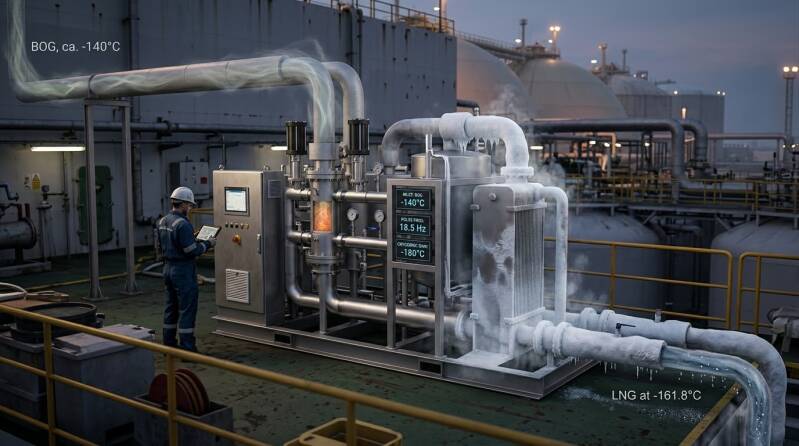
This is an application devised by Bandhan Udeshi.
BOG Reliquefaction with Hydro Puls Direct-Drive (HPDD)
Transforming Costly Boil-Off Vapor into 100% Liquid Yield
During the storage and transport of liquefied natural gas (LNG), external thermal ingress and vessel motion cause continuous product vaporization: Boil-Off Gas (BOG). Traditional methods for managing tank pressure, such as continuous flaring, burning boil-off in auxiliary boilers, or operating complex multi-stage compressor trains, lead to substantial revenue loss, elevated carbon intensity, and severe maintenance burdens.
Hydro Puls Direct-Drive (HPDD) transforms BOG management from an operational liability into a closed-loop, highly efficient recovery cycle. By replacing mechanical rotating drivetrains with direct reactive pulse dynamics, HPDD produces deep cryogenic cooling (-180°C) as an intrinsic, zero-parasitic byproduct, reliquefying vaporized gas with unmatched energy efficiency.
Key Challenges of Conventional Reliquefaction Systems
Existing shipboard and terminal reliquefaction plants encounter strict operational limitations:
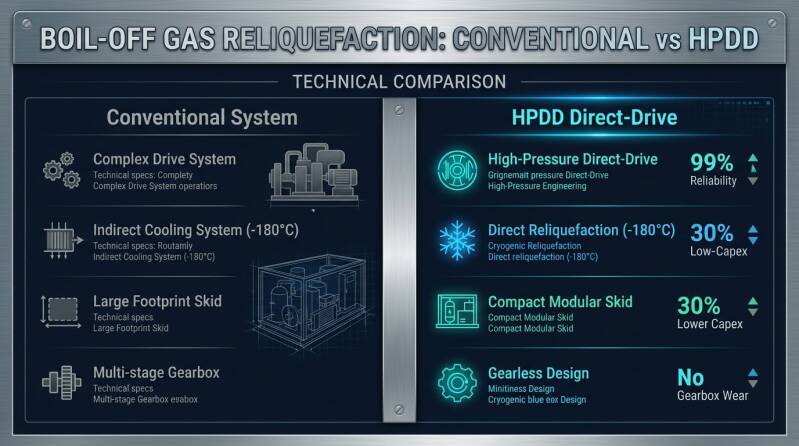
- Bulky Rotating Turbomachinery: Multi-stage centrifugal or reciprocating compressors require heavy gearboxes, electric motor drives, complex oil-free sealing systems, and massive vibration foundations that consume scarce deck space.
- Severe Part-Load Penalties: BOG generation rates vary widely between calm passage, rough sea states, port holding, and transfer operations. Conventional dynamic compressors suffer drastic thermodynamic penalties when throttled or placed on bypass recycle.
- Tightening Maritime Regulations: Under evolving IMO, MARPOL, and FuelEU Maritime standards, methane venting and unnecessary combustion face severe regulatory penalties and emissions taxation.
How HPDD Redefines Boil-Off Management
Core Advantages for Marine & Terminal Operations
Direct Condensation Without External Compression Trains: The cold BOG stream is drawn directly into a compact Printed Circuit Heat Exchanger (PCHE) core cooled by the -180°C pulse sink, returning pure liquid LNG to cargo tanks without auxiliary multi-stage compressor skid overhead.
Exceptional Turndown Flexibility: Transient boil-off spikes and changing weather conditions are managed purely by modulating the pulse stroke frequency rather than choking flow through valves, keeping specific energy consumption flat across the entire operating envelope.
Zero Flaring and Zero Methane Slip: Retains the full energy density of the cargo by converting every kilogram of boil-off back into saleable or usable liquid fuel.
Optimized for FLNG, FSRUs, and Bunkering Vessels: The ultra-compact skid geometry eliminates heavy rotating mass and vibration dampening frames, optimizing deck area, center of gravity, and structural payload limits on floating assets.
Contact Engineering
To evaluate mass-energy balance models, process flow diagrams, and battery-limit integrations for your specific vessel profile or terminal inventory, reach out to our team at info@hpdd.eu.