

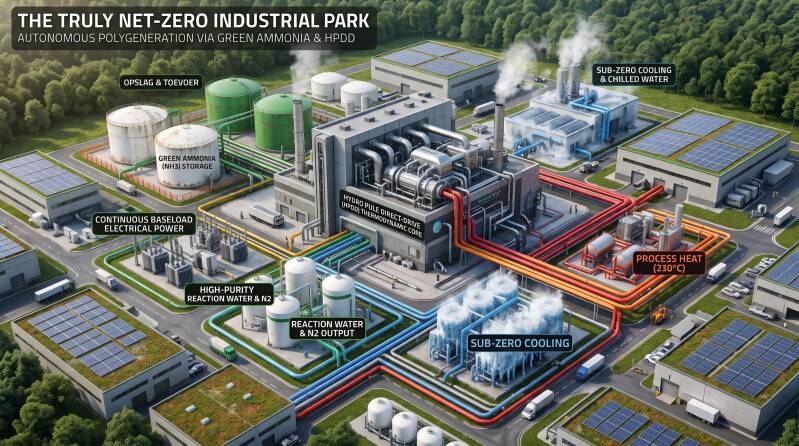
The Truly Net-Zero Industrial Park: Autonomous Polygeneration via Green Ammonia and HPDD
Developing a new industrial hub or high-tech park today almost inevitably runs into the same systemic bottlenecks: saturated regional power grids, strict environmental permitting, water abstraction limits, and soaring energy volatility. Relying solely on conventional grid connections and utility lines leaves master plans stalled for years in interconnection queues.
Designing industrial corridors as autonomous multi-vector microgrids fundamentally changes these economics. Utilizing green ammonia (NH3) as a zero-carbon energy vector paired with a direct-drive thermodynamic core (Hydro Puls Direct-Drive) enables a fully self-sustaining, net-zero industrial ecosystem:
1. Continuous Baseload Electrical Power
Zero dependence on intermittent weather patterns or overloaded transmission lines. The crankless thermodynamic expansion core delivers 24/7 stable, Tier-IV firm power directly behind the meter to run heavy machinery, cleanrooms, and automated production lines.
2. High-Purity Reaction Water (Net Water Producer)
Rather than consuming millions of cubic meters of municipal or groundwater for evaporative cooling towers and utility steam, the reaction of green ammonia yields high-purity water condensate and inert nitrogen (4 NH3 + 3 O2 -> 6 H2O + 2 N2). This demineralized water flows directly into chemical synthesis loops, steam circuits, or electrolysis units without reverse-osmosis pretreatment.
3. Parasitic-Free Sub-Zero Cooling & Chilled Water
Traditional mechanical chiller installations burn 30% to 40% of an industrial park's electrical envelope. Harnessing direct thermodynamic absorption cooling from the expansion cycle delivers sub-zero refrigeration and chilled water for data centers, precision tooling, and cold chain storage, completely bypassing electrical HVAC compressors.
4. High-Grade Industrial Process Heat (230°C)
Via an integrated thermal jacket cascade, the architecture continuously rejects medium-grade process heat and steam at 230°C. This covers industrial drying, pasteurization, and chemical stripping duties on-site without burning gas in auxiliary boilers.
Green ammonia serves as more than just a chemical commodity; it acts as a dense, transportable, multi-month energy vector.
A genuinely net-zero industrial park is not achieved through disjointed offsets, but by harmonizing firm power, pure water, high-grade heat, and deep cooling inside a single closed thermodynamic balance.
#IndustrialParks #EnergyTransition #GreenAmmonia #HPDD #Polygeneration #CleanTech #ProcessEngineering #Decarbonization #HydrogenEconomy