

Why the Rare Earth Bottleneck Isn't in the Mines, but in the Thermodynamics
Geologically, rare earths are not rare. Separating and refining them into magnet-grade purities (such as neodymium, dysprosium, and terbium) is where the supply chain breaks down. Over 90% of global refining capacity remains concentrated in a single country.
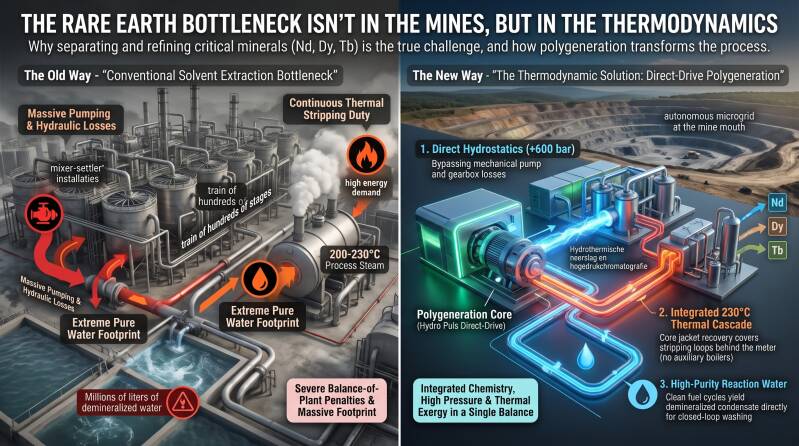
Opening new mines is only step one. Conventional solvent extraction requires trains of hundreds of sequential mixer-settlers and brings severe balance-of-plant penalties:
• Massive Pumping & Hydraulic Losses: Continuously moving solvents and aqueous phases across hundreds of stages demands relentless electrical power.
• Continuous Thermal Stripping Duty: Regenerating complexing agents and chelates requires uninterrupted 200–230°C process steam.
• Extreme Pure Water Footprint: Washing precipitates to prevent cross-contamination consumes millions of liters of demineralized water.
Moving toward advanced refining routes, such as hydrothermal precipitation or high-pressure chromatography, changes commercially when coupled directly to a polygeneration thermodynamic core (like Hydro Puls Direct-Drive):
1. Direct Hydrostatics (+600 bar): Fluid pressure is delivered directly from the core, bypassing mechanical pump and gearbox losses.
2. Integrated 230°C Thermal Cascade: Core jacket recovery covers stripping and regeneration loops behind the meter without auxiliary boilers.
3. High-Purity Reaction Water: Clean fuel cycles yield demineralized condensate directly for closed-loop washing circuits.
Building a truly independent supply chain for critical materials requires on-site refining at the mine mouth: powered by autonomous microgrids that unite chemistry, high pressure, and thermal exergy in a single balance.
#RareEarths #CriticalMinerals #ProcessEngineering #EnergyTransition #Polygeneration #HPDD #SupplyChain #Mining #CleanTech