

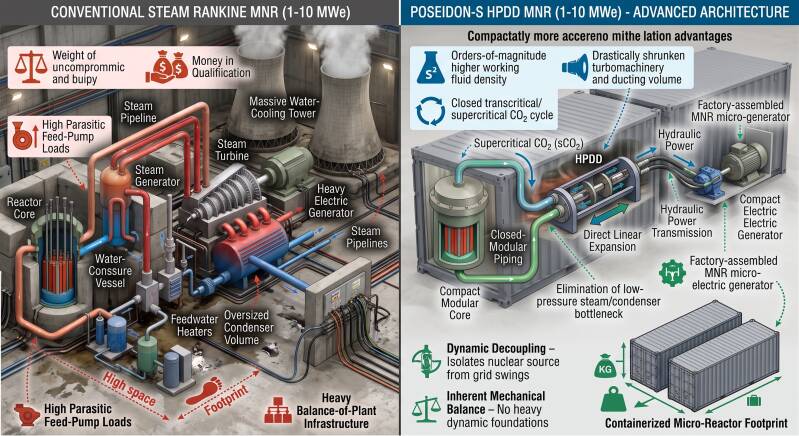
When evaluating Micro Nuclear Reactors (MNRs in the 1–10 MW electrical envelope), conventional steam Rankine cycles hit an uncompromising thermodynamic and spatial wall.
At micro-scale, the footprint, condenser volume, parasitic feed-pump loads, and balance-of-plant weight of steam infrastructure destroy the primary economic advantage of a compact, modular core.
Extending the Hydro Puls Direct-Drive (HPDD) POSEIDON-S architecture into the micro-reactor envelope addresses this bottleneck directly.
Scaling Mechanics Down to 1–10 MW
- Fluid Density Advantage: Operating a closed transcritical or supercritical CO₂ cycle yields orders-of-magnitude higher working fluid density than low-pressure steam. This drastically shrinks turbomachinery and ducting volume, aligning directly with transportable, containerized micro-reactor footprints.
- Direct Linear Conversion: Instead of fragile, high-RPM micro-turbines that lose isentropic efficiency at small mass flow rates, POSEIDON-S utilizes opposed linear pistons to convert dense sCO₂ expansion directly into a pressurized hydraulic fluid column.
- Dynamic Decoupling: The hydraulic power transmission completely isolates the nuclear thermal source from electrical grid swings and mechanical load transients, protecting core thermal stability without oversized balance-of-plant buffers.
- Mechanical Inherent Balance: The opposed-piston design cancels secondary vibrations, eliminating the heavy dynamic foundation requirements typical of rotating thermal plant machinery, crucial for remote base, defense, and island microgrid deployments.
Scaling POSEIDON-S seamlessly from utility SMR blocks down to factory-assembled MNR micro-generators establishes a single, coherent thermodynamic standard across the entire advanced nuclear spectrum.
#NuclearEnergy #MicroReactors #SMR #sCO2 #CleanEnergy #HPDD #PowerGeneration #EnergyTransition #Decarbonization