

Carbon Removal:
Why the Next Phase Belongs to Industrial Energy Systems
A carbon-removal project fails commercially long before it fails chemically.
It fails when power prices make each tonne unpredictable, when heat is unavailable at the required temperature, when compression becomes an afterthought, or when no bankable storage pathway exists.
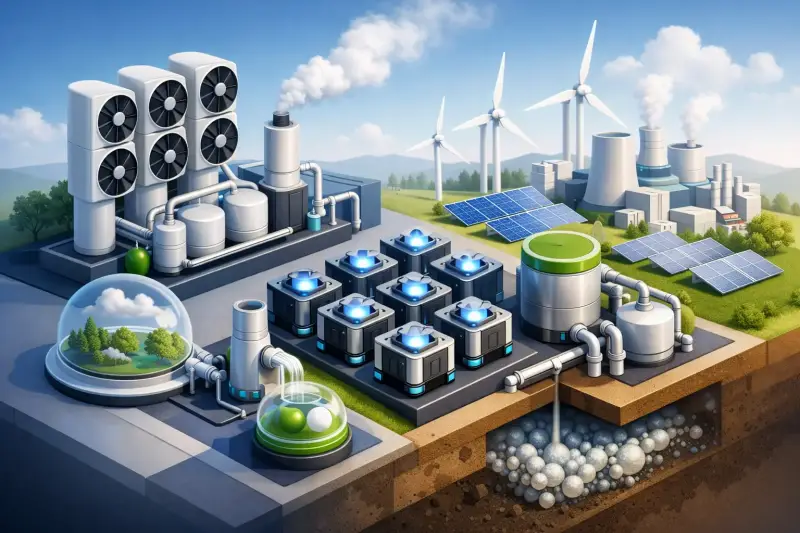
Carbon removal is not just about better sorbents or larger fans, it is about designing removal as an integrated industrial infrastructure system from day one.
1. Carbon Removal is an Infrastructure Challenge
The market is shifting from standalone capture skids to integrated energy islands. Separating dilute or chemically bound CO2 is inherently energy-intensive. The strongest projects match capture chemistry with firm power, usable heat, water recovery, compression, and permanent storage.
2. Firm Energy & Utilization Over Intermittent Peaks
Cheap power for 2,000 hours a year looks great on paper, but capital equipment, compression trains, and chemical loops must be paid for across operating hours. Stable, dispatchable energy yields a lower levelized removal cost by enabling high utilization and fewer thermal cycling shocks.
3. The Multi-Output Thermodynamic Core
A properly engineered energy core must do more than run a capture fan: it should co-deliver electricity, heat, cooling, pure water, and direct compression.
Hydro Puls Systems applies a direct-drive architecture to decouple generation from load variation, eliminating crankshaft-driven transmission losses and turning parasitic auxiliary loads into useful industrial work.
4. Verified Net Tonnes & Storage First
Buyers increasingly demand durable, verifiable storage (mineralization or deep geological injection) over temporary offsets. Without contracted downstream storage, a facility merely produces compressed gas and future liability. Real MRV accounts for the entire lifecycle mass balance.
5. Convergence into Industrial Hubs
Point-source capture (e.g., cement process emissions) and Direct Air Capture (DAC) are converging around shared energy, water, and pipeline corridors. Modeling capture, power, heat recovery, and compression as a single thermodynamic system is essential to project bankability.
Four Questions Before Committing Capital:
What is the verified net removal per tonne after all parasitic and supply chain loads?
What annual utilization is achievable under real energy contracts?
Where does the CO_2 go, and who holds long-term performance liability?
Which co-products (heat, cooling, water, power) improve unit economics?
The future of carbon removal belongs to systems where every unit of energy performs multiple jobs, turning capture from a parasitic expense into productive, resilient industrial infrastructure.
#CarbonRemoval #DAC #DirectAirCapture #CCUS #CleanTech #IndustrialDecarbonization #EnergyTransition #ProcessEngineering #DirectDrive #HPDD #Thermodynamics #NetZero #ClimateTech #HeavyIndustry