

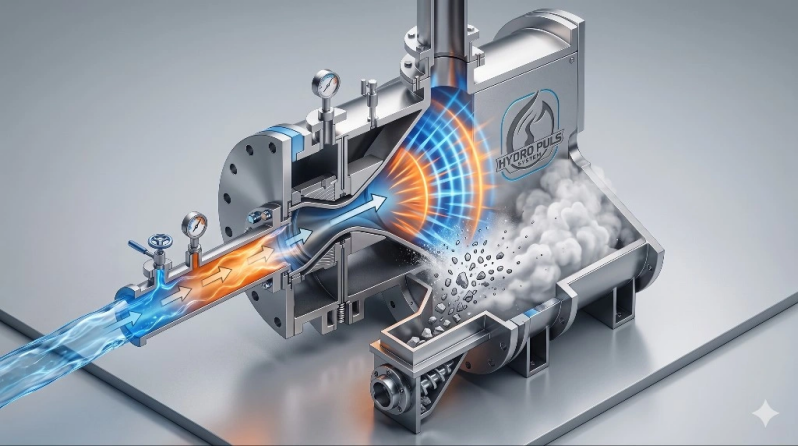
Beyond Emissions: How the HPDD Engine Transforms Waste Gas into a 600-Bar Nitrogen Goldmine for Industry
Rotterdam, July 2026 – While the maritime sector and heavy industries expend billions attempting to scrub harmful nitrogen oxides () and greenhouse gases from their exhaust systems, Dutch-based Hydro Puls Systems BV has bypassed the problem entirely. Their groundbreaking Hydro Puls Direct-Drive (HPDD) platform operates without a traditional chimney or exhaust stack. Instead of producing flue gas, the system terminates its thermodynamic cycle by delivering two sharply separated, ultra-pure streams: distilled freshwater and highly pressurized, bone-dry nitrogen gas.
The Chemistry: How the 600-Bar Nitrogen Stream is Formed
The core of the HPDD module relies on advanced thermochemical recuperation within a closed hydraulic reactor architecture. The system runs on green ammonia (), which is catalytically cracked into an explosive mixture of 80% ammonia and 20% hydrogen on a mass basis just prior to injection.
When this hydrogen-boosted mix undergoes stoichiometric combustion, the reaction kinetics are so aggressive that complete combustion is achieved instantly, making ammonia slip physically impossible. The resulting post-combustion mass is a homogeneous, supercritical mixture of water and nitrogen at an extreme pressure of 600 bar and a temperature of .
This mixture enters a specialized closed separation vessel. By cooling the stream to , the supercritical phase breaks. Liquid water drops to the bottom of the vessel to be recycled or harvested. Meanwhile, pure, dry nitrogen gas () rises to the top, completely isolated and maintained at the full residual process pressure of 600 bar.
Industrial Applications: What Can We Do With 600-Bar Pure Nitrogen?
In traditional engines, nitrogen is a problematic ballast gas that creates pollution. In the HPDD platform, it is a highly valuable, pressurized industrial feedstock. Because it is captured at a native 600 bar without any parasitic compression costs, it unlocks massive operational and economic advantages across three major sectors:
- 1. Cement Manufacturing (The Shockwave Crushing Loop): In cement plants, this high-pressure nitrogen loop is channeled directly back into the processing line to replace energy-intensive mechanical kogelmolens (ball mills). The 600-bar nitrogen acts as a supersonic kinetic hammer, shattering raw limestone from within into sub-micron powder in milliseconds. This enables a 1.5-second convective flash calcination process, cutting plant electricity demands by up to 32%.
- 2. Fertilizer Production (The Circular Economy): Ammonia plants traditionally spend enormous amounts of energy compressing atmospheric nitrogen to feed the Haber-Bosch process. The HPDD’s over-the-fence delivery of pure, dry at 600 bar provides a ready-to-use input for local fertilizer manufacturing, drastically reducing their electrical compression costs and closing the regional chemical loop.
- 3. Merchant Gas Sales & Pure Commercial Commodity: Industrial gas suppliers regularly charge premium rates for high-pressure, high-purity nitrogen used in laser cutting, electronics manufacturing, and pipeline purging. The HPDD allows plant operators to bottle and sell this ultra-pure directly from the source as a lucrative secondary revenue stream.
The On-Site Alternative: Internal Power & Cryogenic Cooling
If not diverted for external industrial processing, the HPDD utilizes this nitrogen internally to maximize onsite efficiency:
- Parasitic-Neutral Power: Expanding the dry nitrogen from 600 bar down to 1 bar through an internal turbine generates 45 kW of mechanical shaft work, helping render the entire system 100% self-sufficient.
- Free Cryogenic Cooling: As the nitrogen expands out of the turbine, its temperature plummets to , yielding of direct cryogenic cooling capacity per module. This "free cooling" can chill data centers, cold storage facilities, or HVAC systems before the inert gas dissipates harmlessly into the atmosphere.
With the HPDD platform, zero-emission engineering is no longer an operational expense. By treating atmospheric components as valuable chemical assets, it proves that heavy industry can achieve absolute sustainability while aggressively boosting its bottom line.
Note to editors (not for publication): For deep-dives into the fluid mass balances of the v26 architecture, technical whitepapers, or interview requests with founder Gerd Van Driessche, please contact:
Media Contact: Hydro Puls Systems BV