

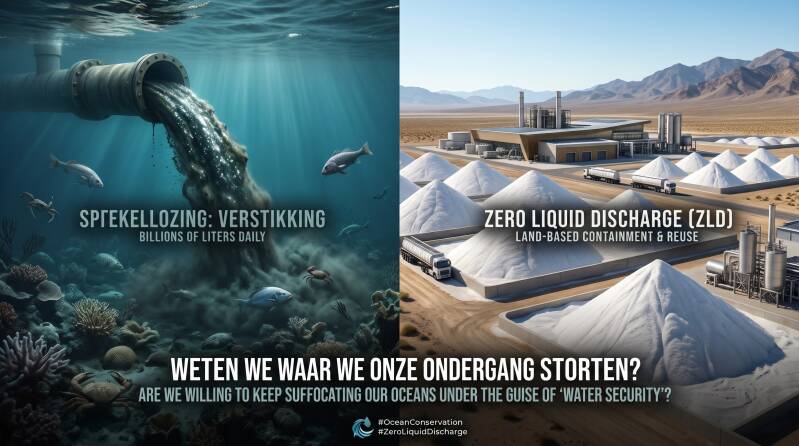
Are we willing to keep suffocating our oceans under the guise of "water security"?
Whenever Zero Liquid Discharge (ZLD) and deep brine concentration are discussed, a common pushback arises: "If we crystallize the brine, what do we do with all the excess sodium chloride?"
That question fundamentally misses the ecological baseline.
Every single day, desalination plants dump billions of liters of hypersaline, high-temperature, and chemical-treated brine (antiscalants, biocides) back into fragile coastal waters like the Arabian Gulf and the Mediterranean.
The consequences on the seabed are devastating:
• Benthic Hypoxia: Dense, hyper-concentrated brine sinks to the seafloor, suffocating oxygen and creating expanding marine dead zones.
• Habitat Destruction: Coral reefs bleach and die, fish nurseries vanish, and local marine biodiversity collapses.
• Zero Dilution Reality: In shallow, semi-enclosed seas where natural water turnover takes decades, we are actively toxifying the very source we rely on for life.
Now look at the land-based alternative:
Dry, crystallized sodium chloride is non-volatile, completely inert, and straightforward to contain in arid environments. High-purity fractions directly feed local chlor-alkali and industrial chemical supply chains; surplus volumes can safely serve in engineered storage caverns or dry containment.
A managed pile of dry mineral salt on land creates zero active ecotoxicity. A continuous toxic liquid plume in the ocean actively destroys living marine habitats every single hour.
Moving toward ZLD through direct-drive fluid power (HPDD) is not just about mineral valorization. It is about drawing an absolute line against using our oceans as an open industrial dumping ground.
#Desalination #OceanConservation #ZeroLiquidDischarge #ZLD #WaterSecurity #MarineEcology #BrineManagement #CleanTech #Sustainability #HydroPuls