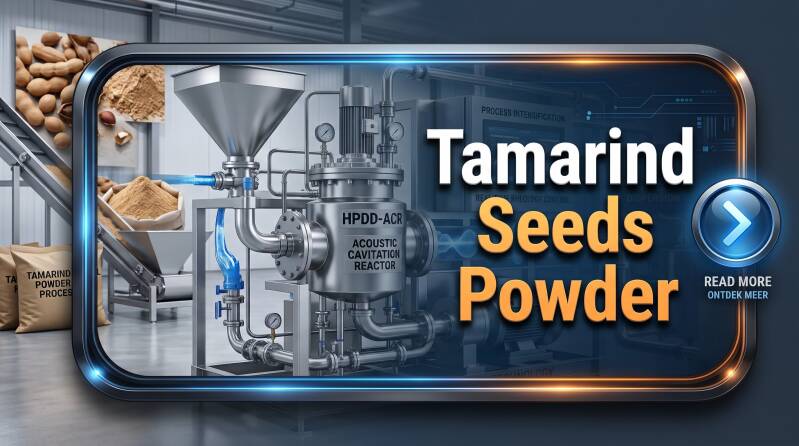
HPDD-ACR Process Intensification for Tamarind Kernel Powder (TKP)
Advanced Acoustic Cavitation for Bio-Polymer Processing and Functionalization
Tamarind Kernel Powder (TKP) is an abundant, high-value source of xyloglucan, a neutral polysaccharide offering exceptional hydrocolloid properties for textile printing, protective bio-coatings, and advanced fertilizer granulation. However, conventional industrial processing faces persistent bottlenecks: slow hydration kinetics, lump formation, microbial contamination risks, and frequent screen clogging.
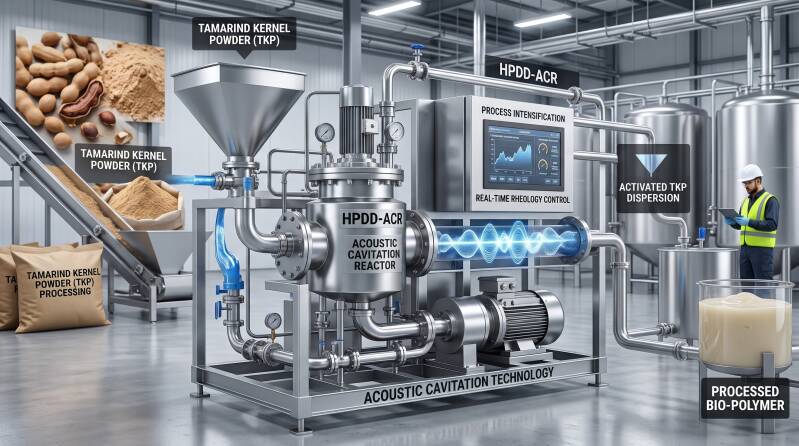
By integrating the Hydro Puls Direct-Drive Acoustic Cavitation Reactor (HPDD-ACR), traditional batch-milling and high-temperature thermal dissolution are transformed into a continuous, inline, and energy-efficient platform that delivers precise control over purity, rheology, and viscosity.
Key Operational Advantages of HPDD-ACR in the TKP Value Chain
1. Accelerated Polysaccharide Extraction & Cold Dispersion
- Mechanically Driven Cell Wall Disruption: The target xyloglucan polymer is tightly locked within the dense seed endosperm matrix. The intense acoustic cavitation shockwaves and localized micro-jet shear forces of the ACR disrupt cell walls rapidly and thoroughly, eliminating the need for aggressive chemical reagents.
- Agglomeration-Free Cold Dispersion: Standard TKP processing demands heated water and extended soaking to achieve dispersion, frequently resulting in unhydrated core lumps ("fish eyes"). The micro-turbulent cavitation field achieves uniform dispersion and full hydration at the microscopic scale under lower operating temperatures, preserving macromolecular integrity against thermal degradation.
2. Precision Rheology & Viscosity Control
- Controlled Macromolecular Tailoring: TKP exhibits pseudoplastic, non-Newtonian flow behavior. Regulated acoustic pulses allow precise deagglomeration and controlled partial scission of long-chain polymers, enabling exact targeting of customer-specified viscosity curves.
- Elimination of Screen Clogging: In fine applications, such as rotary screen textile printing where formulations must clear fine meshes under 60 microns, homogenization through the ACR eradicates micro-aggregates, eliminating nozzle fouling and ensuring steady flow dynamics.
3. Enhanced Decontamination, Purity & Shell Separation
- Non-Chemical Microbial Control: Natural bio-polymers are inherently vulnerable to bacterial growth and batch-to-batch contamination. The extreme pressure differentials and acoustic shock fronts cause physical cell lysis of vegetative bacteria and fungal spores, lowering the overall bioburden without chemical preservatives.
- Clean Seed-Coat Stripping: In wet-milling loops, cavitation shear forces cleanly detach and separate the brittle outer seed testa from the cotyledons, preventing non-viscous fractions and coloring agents from degrading end-product purity.
Transitioning from Batch Agitation to an Inline Continuous Platform
The HPDD-ACR architecture replaces energy-intensive batch cookers, heavy agitators, and long residence times with a compact, skid-mounted continuous flow-through system. The result is substantially reduced operating energy, consistent batch reproducibility, and superior polysaccharide quality for high-grade industrial applications.
Would you like to evaluate how the HPDD-ACR skid integrates into your current processing stream (such as continuous aqueous dispersion, cold peeling, or microbial reduction)? Contact our application engineering team to initiate technical screening.