

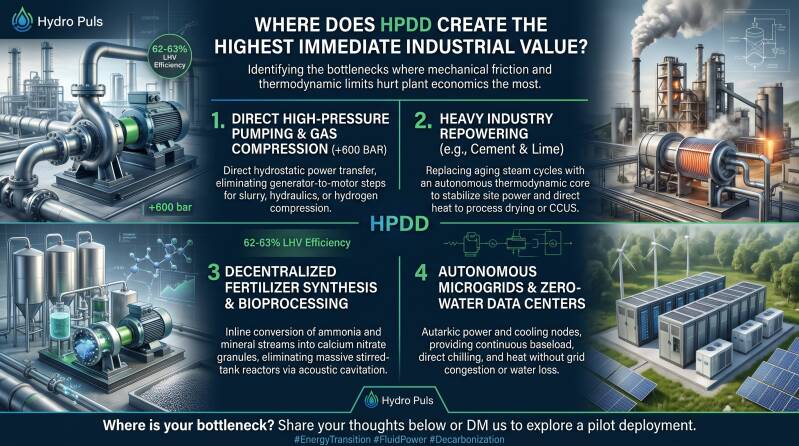
Where does the Hydro Puls Direct-Drive (HPDD) platform create the highest immediate industrial value?
The thermodynamic baseline of our crankshaft-free, linear direct-drive core is verified: 62–63% net LHV efficiency, direct conversion into high-pressure fluid power (+600 bar) and electricity, and native fuel flexibility across hydrogen, syngas, and ammonia.
As we prepare our next pilot demonstration program, our goal is to build it around the operational challenge where mechanical friction and thermodynamic bottlenecks hurt plant economics the most.
We see four primary deployment fronts:
1. Direct High-Pressure Pumping & Gas Compression (+600 bar)
Eliminating intermediate generator-to-inverter-to-motor steps. Direct hydrostatic power transfer for heavy slurry pumping, hydraulic machinery, or pipeline hydrogen compression.
2. Heavy Industry Repowering (e.g., Cement & Lime)
Replacing aging, maintenance-heavy steam cycles with an autonomous thermodynamic core that stabilizes site power while directing high-grade thermal enthalpy toward process drying or carbon capture regeneration.
3. Decentralized Fertilizer Synthesis & Bioprocessing
Inline conversion of merchant ammonia and mineral side-streams into high-purity calcium nitrate granules, using acoustic cavitation and reaction exotherm to eliminate massive stirred-tank reactors.
4. Autonomous Microgrids & Zero-Water Data Centers
Autarkic power and cooling nodes providing continuous baseload generation, direct chilling, and usable heat without grid congestion or evaporative cooling water loss.
To process engineers, plant operators, and project developers:
Where in your operations do you see the most persistent bottleneck that a direct-drive fluid power pilot could eliminate?
Share your perspective in the comments or send a direct message to explore a pilot deployment.
#Engineering #EnergyTransition #ProcessEngineering #Decarbonization #FluidPower #Hydrogen #HydroPuls #CleanTech #Innovation