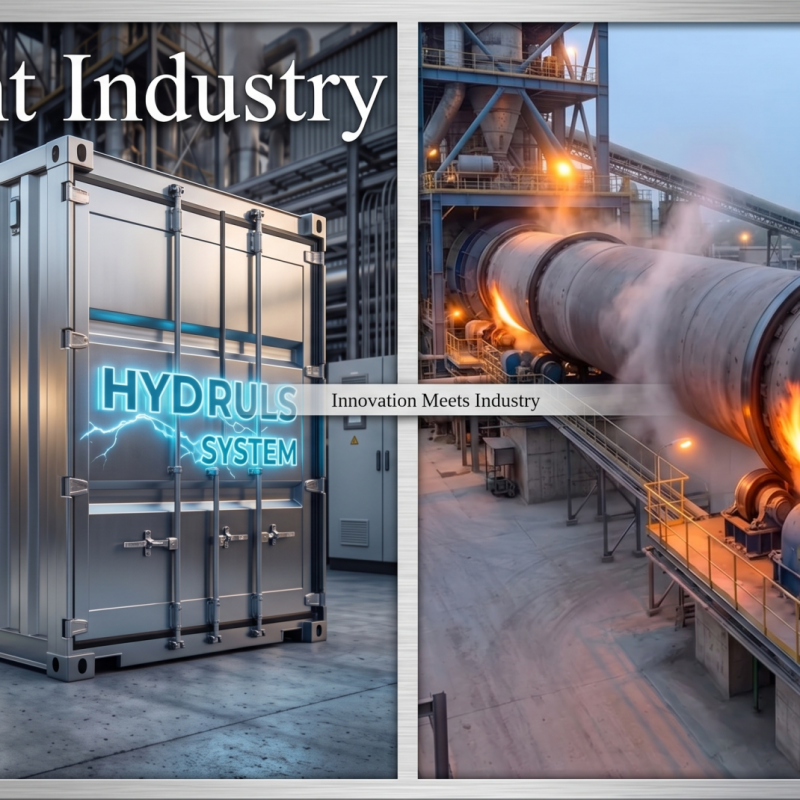
Rewriting Cement Manufacturing: Turning Industrial Emissions into High-Grade Fertilizer on the Plant Floor
The global cement industry faces a monumental challenge, accounting for roughly 8% of worldwide CO2 emissions. Conventional decarbonization routes are heavily constrained by high capital expenditures and the safety risks of storing, handling, and transporting bulk hydrogen or green ammonia across public infrastructure.
In collaboration with Professor Mohamed Amin (Associate Professor at Al-Azhar University, Rutgers University, and the University of Debrecen), we are introducing a breakthrough thermodynamic integration built on the Hydro Puls Direct-Drive (HPDD) platform: "Engineered 1-Micron Cement & Fluidic Nitration Swarms."
Instead of venting side-streams or transporting volatile chemical intermediates, the HPDD operates directly on the plant floor as a self-contained, closed-loop industrial refinery core:
Thermodynamic Architecture & Process Synergy:
• Internal Thermal Recuperation: Mantle heat from the isolated combustion zone powers the thermal cracking of ammonia fuel into hydrogen (H2) and nitrogen (N2).
• Precise Material Stabilization: Continuous cooling via ammonia vaporization keeps core Inconel components stabilized at a uniform 230°C, controlling thermal expansion to precisely 109 µm.
• Supersonic Shockwave Calcination at 600 Bar: Isolated nitrogen is delivered at 600 bar as a high-velocity mass flow, acting as the kinetic driver for supersonic shockwave deagglomeration of hot lime (CaO).
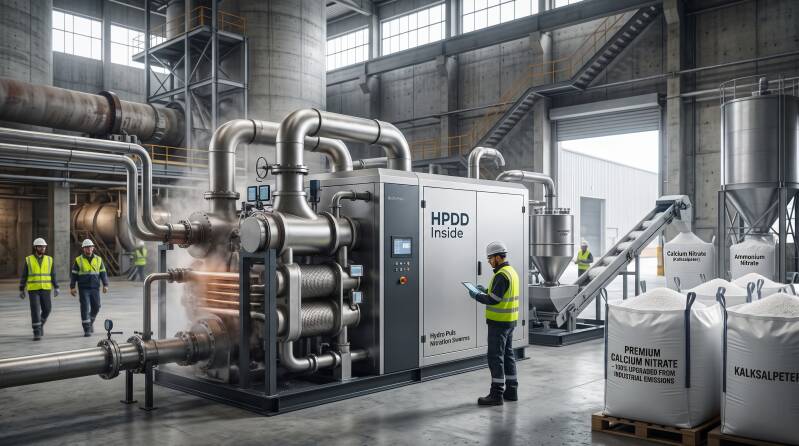
• Exothermic Fertilizer Synthesis: Compressed nitrogen, superheated process water, and highly reactive micronized CaO meet in an automated fluidic reactor. The self-sustaining exothermic reaction rapidly synthesizes high-purity, stable Calcium Nitrate (Kalksalpeter) and Ammonium Nitrate mineral fertilizers right at the source.
Commercial Advantages for Heavy Industry:
1. Zero Transport Liability: Eliminates the logistical hazards and regulatory friction of moving volatile gaseous ammonia or high-pressure hydrogen over public corridors.
2. Premium Agricultural Revenue: Converts industrial side-streams into high-value, market-ready fertilizer commodities that can be shipped as standard, stable bulk cargo.
3. Maximum System COP: By unifying mechanical fluid power, internal recuperative thermal cracking, and exothermic chemical synthesis, the integrated facility achieves an unmatched overall system efficiency.
Through the "HPDD Inside" framework, we provide the autonomous thermodynamic engine that empowers leading industrial thinkers and academic partners to transform heavy industry from first physical principles.
#CementIndustry #HeavyIndustry #Decarbonization #ProcessEngineering #CleanTech #HydroPuls #CircularEconomy #Fertilizer #IndustrialInnovation