Chemical BESS vs. HPDD-BESS: Fundamental Differences in Energy Storage
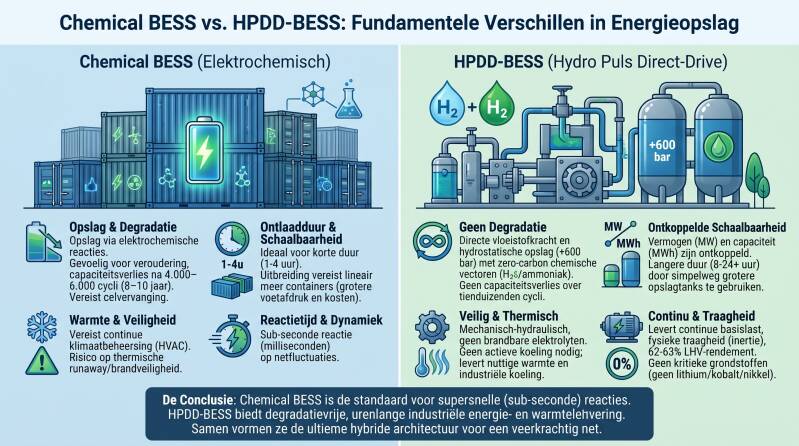
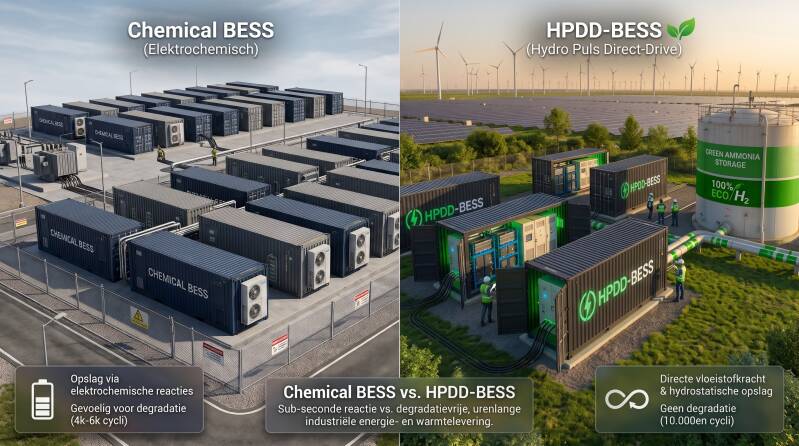
When addressing utility-scale energy storage (BESS), the market conventionally looks toward electrochemical battery banks (such as Lithium Iron Phosphate / LFP). For heavy industrial applications, microgrids, and long-duration grid stabilization, the Hydro Puls Direct-Drive (HPDD-BESS) platform introduces a fundamentally different physical architecture.
Here is how the two technologies compare across core operational parameters:
1. Storage Medium and Degradation
• Chemical BESS: Stores electricity via electrochemical reactions within battery cells. This mechanism is subject to unavoidable cyclic and calendar aging. After 4,000 to 6,000 full-depth discharge cycles (or 8–10 years), significant capacity loss requires capital-intensive cell replacement.
• HPDD-BESS: Relies on direct fluid power and hydrostatic energy storage operating at +600 bar, coupled with zero-carbon chemical vectors (such as hydrogen or green ammonia). Without electrochemical cells to degrade, the system eliminates cyclic capacity fade across tens of thousands of operating cycles.
2. Discharge Duration and Scalability (MWh vs. MW)
• Chemical BESS: Ideal for short-duration peaks (1 to 4 hours). Extending duration to multi-hour or multi-day regimes (8 to 24+ hours) requires linear additions of battery containers, driving up site footprint and capital expenditure.
• HPDD-BESS: Power rating (MW) and energy storage capacity (MWh) are decoupled. Increasing storage duration is accomplished simply by sizing up atmospheric storage tanks, without expanding the prime mover machinery.
3. Thermal Management and Safety
• Chemical BESS: Demands continuous climate control (HVAC) and presents operational risks related to thermal runaway and fire safety.
• HPDD-BESS: Functions via a mechanical-hydraulic architecture free of flammable electrolytes. Instead of consuming parasitic power for cooling, the system natively discharges usable high-grade thermal energy and industrial chilling.
4. Response Time and Grid Dynamics
• Chemical BESS: Delivers sub-second, millisecond-level response to transient frequency events and voltage sags, serving as a primary shock absorber.
• HPDD-BESS: Supplies continuous baseload generation, genuine physical inertia, and 62–63% net LHV efficiency running on clean fuels, without reliance on critical raw materials like lithium, cobalt, or nickel.
The Takeaway:
A chemical BESS remains the benchmark tool for instantaneous sub-second response. HPDD-BESS delivers the degradation-free endurance required for deep, multi-hour industrial energy and thermal dispatch. Deployed together, they form a balanced hybrid architecture for modern grid resilience.
#EnergyStorage #BESS #GridStability #CleanTech #PowerEngineering #HydroPuls #Decarbonization #FluidPower #Microgrids