

Decentralized Fertilizer Production: Why Regional Distributors Choose Granulation Over Crystals
In agricultural growth markets across India, Sri Lanka, and Egypt, reliance on imported calcium nitrate creates ongoing exposure to supply chain volatility and currency fluctuations. Establishing modular, decentralized production units—such as 25 tons per day (tpd)—offers a viable path to substitute imports and shorten logistics.
When sizing these distributed facilities, plant operators face a core engineering choice: dry powder crystals or uniform granules?
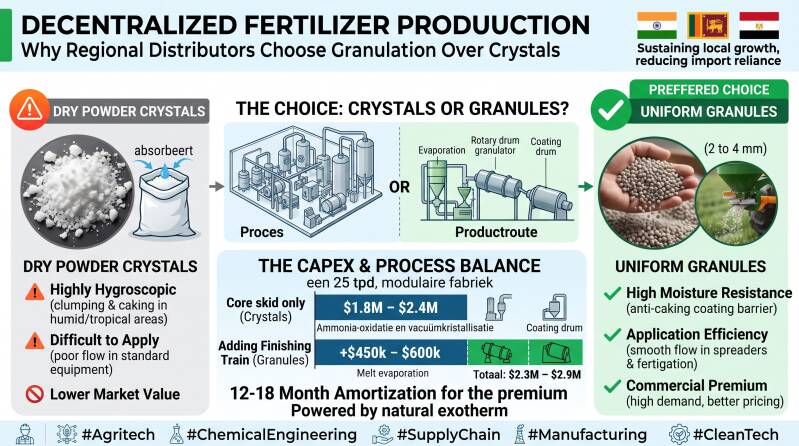
Why the Market Demands Granules:
• Moisture Resistance: Pure calcium nitrate crystals are highly hygroscopic. In humid or tropical environments, bagged crystals cake and harden quickly, leading to storage losses.
• Application Efficiency: Sized 2 to 4 mm granules flow smoothly through modern agricultural fertilizer spreaders and automated fertigation systems.
• Commercial Premium: Granular product commands a consistent price premium per ton over raw crystal mass among distributors and farmers.
The Process and Capex Balance:
Converting merchant ammonia and hydrated lime (calcium hydroxide) directly into fertilizer crystals requires a core skid featuring catalytic ammonia oxidation, cavitation-assisted slurry absorption, and vacuum crystallization, with a Capex envelope of roughly $1.8M – $2.4M.
Adding a complete finishing granulation train requires:
• High-concentration melt evaporation
• A rotary drum or fluidized-bed granulator
• Vibratory screening circuits with oversize/undersize recycle loops
• A fluidized-bed cooler
• An anti-caking coating drum applying a protective moisture barrier
This finishing circuit adds approximately $450,000 to $600,000, bringing total modular facility Capex to ~$2.3M – $2.9M. In high-demand regional markets, the higher market price for granules typically amortizes the additional capital expenditure within 12 to 18 months.
By harnessing the natural exotherm of ammonia oxidation to power evaporation and deploying acoustic reactor dynamics to eliminate fouling agitators, local operators can deliver high-grade granules with minimal parasitic power.
#Agritech #Fertilizer #ChemicalEngineering #ProcessIntensification #Decarbonization #SupplyChain #Manufacturing #CleanTech