

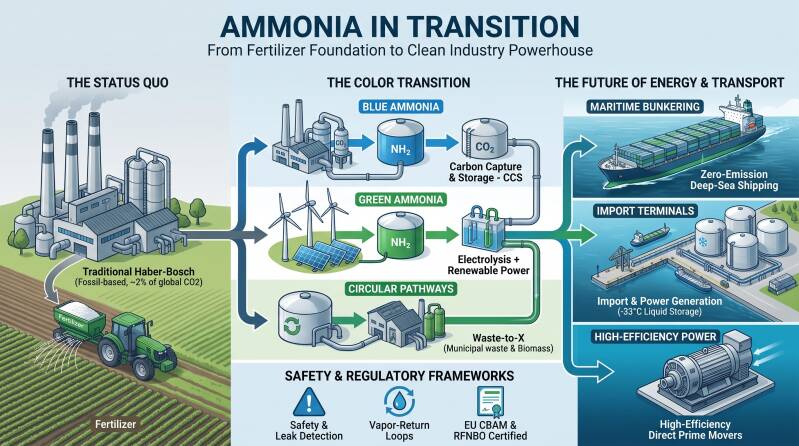
Ammonia in Transition: From Fertilizer Foundation to Clean Industry Powerhouse
The global ammonia industry stands at a pivotal historical turning point. While ammonia (NH_3) has historically served primarily as the baseline feedstock for mineral nitrogen fertilizers, it is rapidly emerging as a strategic zero-carbon energy vector for deep-sea shipping, industrial heating, and heavy-duty decarbonization. The market is shifting decisively from legacy fossil synthesis toward circular, low-carbon production pathways.
Current Status: The Dominance of Haber-Bosch
Global ammonia production currently stands at approximately 180 to 190 million metric tons per year. The overwhelming majority of this volume is produced via the traditional Haber-Bosch process coupled with Steam Methane Reforming (SMR) of natural gas or coal gasification.
While this conventional synthesis route is highly optimized chemically, its environmental footprint remains severe: legacy gray ammonia accounts for roughly 1.5% to 2% of total global industrial CO_2 emissions. This has accelerated commercial deployment across alternative production tiers:
- Blue Ammonia: Conventional fossil synthesis equipped with Carbon Capture and Storage (CCS), targeting 85% to 95% permanent carbon mitigation.
- Green Ammonia: Electrolytic hydrogen generated via dedicated renewable power (wind and solar) paired with cryogenic air separation units (ASU).
- Circular & Waste-to-X Pathways: Non-fossil syngas generated from secondary carbon feedstocks—such as municipal solid waste, end-of-life plastics, and biomass—via high-temperature or plasma-assisted gasification.
Outlook: Expanding Beyond Agriculture
Future demand is expected to decouple from pure agricultural fertilizer growth, driven by key industrial energy sectors:
- Maritime Bunkering: The International Maritime Organization (IMO) emissions reduction mandates are compelling shipowners toward clean chemical vectors. Ammonia offers a distinct volumetric energy density advantage over liquid or compressed hydrogen, establishing it as a front-running candidate for deep-sea container and bulk transport corridors.
- Import Terminals and Power Generation: Energy-importing economies across Europe and East Asia are investing heavily in terminal infrastructure to import ammonia as an unpressurized liquid carrier, both for hydrogen cracking and for direct thermal generation.
- High-Efficiency Direct Prime Movers: The traditional round-trip efficiency penalty of ammonia is being tackled by novel conversion architectures. Bypassing legacy rotary crankshaft engines in favor of direct, linear hydrostatic prime movers (reaching net LHV efficiencies up to 62%) alters the exergy equation for heavy industrial use cases.
Procedures and Safety Frameworks: Operational Standards
Scaling ammonia beyond specialized chemical plants into global logistics hubs demands strict regulatory protocols. Because ammonia is a toxic, pungent, and mildly corrosive compound at ambient conditions, operations adhere to precise industrial guidelines:
- Storage and Liquefaction Regimes: Commercial bulk volume is stored refrigerated as an atmospheric liquid at -33°C, or alternatively under 8 to 10 bar of pressure at ambient temperatures in bullet tanks. Port terminals require closed-circuit re-liquefaction compressors to continuously catch, re-condense, and return boil-off gases (BOG) to storage without atmospheric venting.
- Bunkering and Transfer Controls: Marine bunkering and truck/rail loading procedures mandate dry-disconnect couplings, emergency release systems (ERS), and fully closed vapor-return loops to prevent fugitive emissions. Safety boundaries require fixed multi-point gas detection arrays and perimeter water curtains to neutralize potential leak pathways.
- Regulatory Compliance & Tracking: International frameworks—such as the EU Carbon Border Adjustment Mechanism (CBAM) and Renewable Energy Directive (RED III)—require strict chain-of-custody documentation. Operators must provide rigorous mass-balance accounting and lifecycle emissions verification to certify feedstocks as certified renewable fuels of non-biological origin (RFNBO).
The ongoing transformation across the ammonia value chain demonstrates that industrial decarbonization is not solely about introducing new chemical molecules, but rather about deploying closed-loop procedures, advanced safety systems, and high-efficiency prime movers to utilize proven chemical carriers safely.