

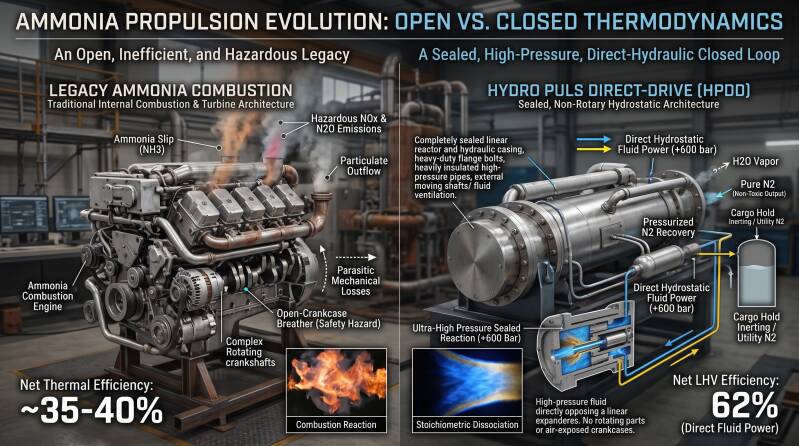
"Ammonia as a fuel is dangerous, inefficient, and fundamentally an open thermodynamic system."
This is an understandable reaction from experienced chemical process engineers and thermodynamicists. If evaluated through the lens of legacy combustion machinery, that critique is entirely justified.
Injecting ammonia into a standard internal combustion engine or gas turbine runs directly into fundamental physical barriers:
1️⃣ Low flame velocities cause incomplete combustion and ammonia slip.
2️⃣ Open-crankcase breathers and exhaust stacks create an open path to atmosphere, posing severe toxicity risks while generating secondary particulates, NOx, and high-GWP nitrous oxide (N2O).
3️⃣ Crankshaft assemblies, alternators, and intermediate compressors compound parasitic mechanical losses, capping net thermal efficiency around 35–40% and severely penalizing round-trip figures on a Sankey diagram.
The issue is not the ammonia molecule itself, but forcing a high-density chemical vector through 19th-century mechanical architectures.
How the Hydro Puls Direct-Drive (HPDD) fundamentally shifts this equation:
🔹 Closed Reactor Dynamics Instead of an Open Engine:
The HPDD operates without open atmospheric exhaust. Linear chemical expansion takes place against a hydrostatic fluid column in a sealed chamber, with zero open crankcase breathers and no lube-oil contact.
🔹 Reaction Kinetics at +600 Bar:
Operating under ultra-high hydrostatic pressures with precise stoichiometric metering drives ammonia dissociation cleanly into pure nitrogen (N2) and water vapor (H2O). Thermal pathways for NOx and N2O formation are suppressed at the source, while the pressurized nitrogen is recovered directly for on-site utility (such as cargo hold inerting).
🔹 Direct Hydrostatic Power (62% Net LHV Efficiency):
Instead of converting linear thrust into rotary motion, electrical generation, and downstream mechanical pumping, the HPDD outputs high-pressure fluid power (+600 bar) directly. Removing the intermediate mechanical and electrical conversion train preserves cycle exergy.
Extraordinary claims require empirical proof. Prototype validation trials are actively substantiating these thermodynamic boundaries with independent data.
Decarbonizing heavy transport and industry will not come from patching century-old engines with alternative fuels, but from rethinking the prime mover from the laws of thermodynamics up.
How is your engineering team approaching the boundary between conventional prime movers and closed-loop linear reactors?
#GreenAmmonia #HPDD #HydroPuls #EnergyTransition #CleanTech #Thermodynamics #Engineering #Innovation #Decarbonization