

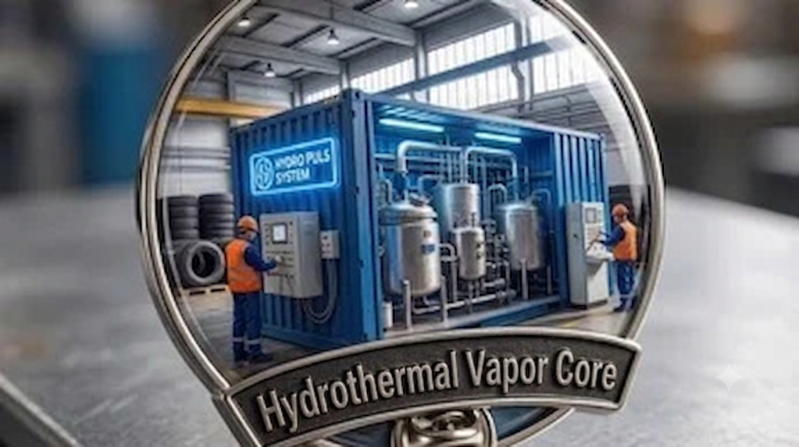
Why We Are Renaming the Carbon Monolith to the "Hydrothermal Vapor Core" (HVC)
Engineering terms must reflect functional reality.
Labeling our high-surface-area reaction element simply as a "Carbon Monolith" anchored perception to a single material or narrow recovered carbon black (rCB) duty. In practice, this module serves a vastly wider operational envelope across high-pressure process engineering.
We are standardizing its technical designation to: Hydrothermal Vapor Core (HVC).
The shift reflects dozens of critical process applications enabled by the core’s geometry, thermal stability, and non-sliding fluidic boundary:
* Hydrothermal Carbonization & Valorization: Processing wet organic and industrial slurries into high-value solid carbon matrices without energy-intensive pre-drying.
* Superheated Vapor & Flash Reactions: Sustaining ultra-fast gas-phase mass transfer under continuous pressure pulses without structural degradation or channel erosion.
* Catalytic Gas Reforming & Synthesis: Acting as a robust, non-degrading substrate for high-temperature synthesis loops where traditional packed catalyst beds suffer from attrition, pressure drops, and coking.
* Deep Adsorption & Multiphase Separation: Providing extreme active surface area for continuous-flow impurity stripping, moisture flash-off, and target molecule capture.
* Closed-Loop High-Pressure Fluidics: Operating fully integrated into our 600-bar direct-drive architecture, completely isolated from dynamic mechanical wear parts.
Nomenclature matters during institutional and EPCM engineering due diligence. Moving to the Hydrothermal Vapor Core accurately frames the unit as a multi-utility chemical processing engine, rather than just a static material block.
Continuous execution requires precise terminology.
#ProcessEngineering #ChemicalEngineering #Hydrothermal #DeepTech #IndustrialInnovation #HydroPulsDirectDrive #CleanTech