

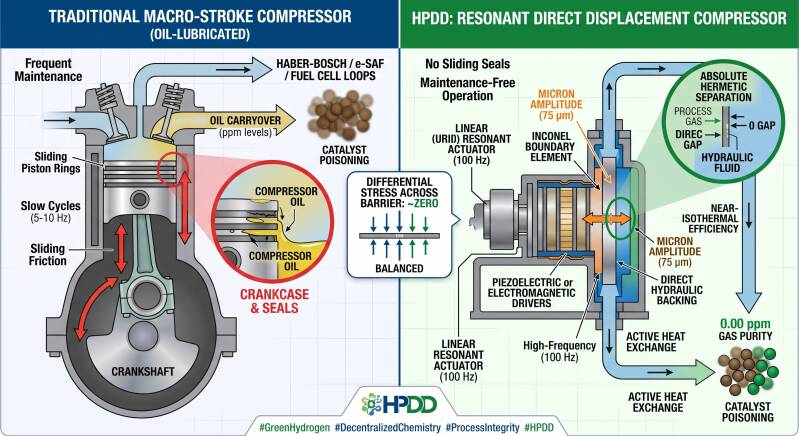
Every chemical engineer running Haber-Bosch, e-SAF, or fuel-cell loops knows the silent plant killer: compressor oil carryover.
Even fractions of a part per million of lubricant passing through multi-stage compressor seals will gradually blind expensive ruthenium, iron-wüstite, or precious metal catalyst beds.
To get true 0.00 ppm purity at high pressure, the industry often relies on slow, expensive metal diaphragm compressors with massive footprints and frequent maintenance intervals.
The alternative is transitioning from slow macro-strokes to high-frequency micro-fluidics.
By driving an Inconel boundary element with a mere 75-micron amplitude at 100 Hz:
- The displacement is entirely elastic—eliminating mechanical friction and seal degradation.
- Direct hydraulic backing absorbs the process pressure (200 to 600 bar), keeping differential stress across the barrier near zero.
- The high-frequency fluid column acts as an active heat exchanger, pulling heat directly out of the compression stroke for near-isothermal efficiency.
No crankshafts. No sliding rings. Absolute hermetic separation between hydraulic driver and reaction gas.
Decentralized chemical synthesis doesn't just need cheaper green molecules; it needs compressor architecture that doesn't poison the reactor.
Is the industry ready to move away from rotating crankshaft compressors toward resonant direct displacement?
#GreenHydrogen #DecentralizedChemistry #AmmoniaSynthesis #CleanTech #ProcessIntegrity #HPDD #Innovation