

The fundamental flaw in modern gas compression isn’t the thermodynamics, it’s the sliding friction.
When you compress hydrogen or synthesis gases to 200+ bar using mechanical pistons, you are forced into an engineering compromise:
1. Use dynamic seals and crankcase lubricants, risking catalyst poisoning (lubricant carryover).
2. Fight high side-thrust forces that ovalize cylinder bores and accelerate wear.
What if you eliminate sliding dynamic seals entirely?
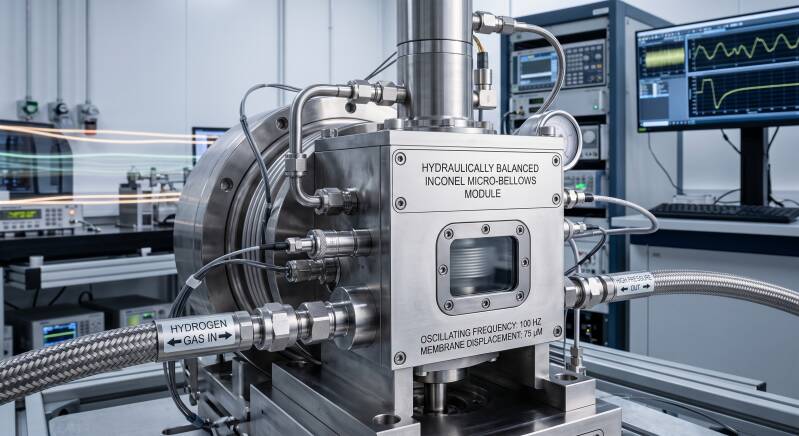
Consider this architectural shift: a hydraulically balanced Inconel micro-bellows oscillating at 100 Hz with a displacement of just 75 microns.
Why 75 µm at 100 Hz works where macro-strokes fail:
* Infinite Fatigue Life: A 75-micron deflection keeps stress amplitudes far below the endurance limit of high-nickel superalloys. The material stays strictly in its elastic zone, cycling millions of times without fatigue failure.
* Hydrodynamic Pressure Balancing (ΔP ≈ 0): The static 200+ bar pressure isn't carried by the thin metal wall; it is backed by an incompressible fluid column behind it. The bellows only experiences a working differential of 1 to 3 bar.
* High Frequency Replaces Stroke Length: You don't need a 100 mm mechanical stroke to move industrial volume. Pairing a 200 mm diameter membrane with 100 Hz acoustic-speed kinetics delivers continuous, near-isothermal mass displacement.
* Absolute 0.00 ppm Hermetic Integrity: No dynamic piston rings. No sliding wear surfaces. Zero lubricant interface. The process gas touches only pure metal.
Compressor engineering has spent a century trying to perfect dynamic mechanical seals. Perhaps the real breakthrough is designing a system that makes them obsolete.
Curious to hear from compressor specialists and materials engineers: where do you see the limits of high-frequency micro-deflection in extreme gas kinetics?
#CompressorEngineering #HydrogenCompression #HPDD #MechanicalEngineering #FluidDynamics #ChemicalEngineering #ProcessEngineering