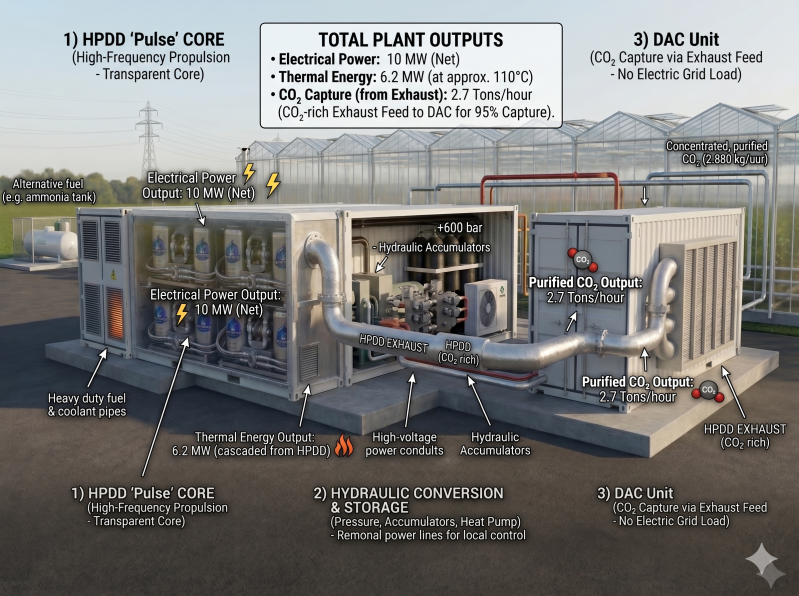
Oversizing a CHP plant is one of the fastest ways to destroy project economics while still believing the system looks impressive on paper. Undersizing it can be just as expensive - not because the machine fails, but because the site keeps buying peak electricity and auxiliary heat that the plant was meant to displace. That is the real starting point for how to size modular CHP plants: not nameplate ambition, but the interaction between thermal demand, electric demand, operating profile, fuel path, and controllability.
For industrial operators, developers, and infrastructure investors, sizing is not a spreadsheet exercise done after equipment selection. It is the central design decision that determines run hours, heat utilization, dispatch value, emissions profile, maintenance cadence, and the ability to expand without stranding capital. In a modular architecture, that decision becomes more powerful because capacity can be staged. It also becomes less forgiving, because poor module selection can lock a project into inefficient part-load behavior or unnecessary complexity.
How to size modular CHP plants from the load first
The first principle is simple: CHP is usually sized to the useful thermal load, not the maximum electrical load. That is because wasted heat is destroyed value. If a site can only use a fraction of the recovered thermal energy for most of the year, the theoretical efficiency advantage of CHP collapses into a poor real-world asset utilization profile.
That does not mean electricity is secondary. It means thermal demand typically sets the lower-risk baseload case. In greenhouses, district energy, food processing, drying, desalination, and many industrial campuses, the recurring demand for low- to medium-grade heat is what gives CHP its economic backbone. Electrical output then becomes the high-value co-product.
The practical implication is that hourly or sub-hourly load data matters more than annual consumption totals. A plant designed around annual averages often looks reasonable until seasonal swing, night setback, process shutdowns, or batch operation are mapped against actual recovery capacity. Then the mismatch appears.
Start with three demand curves, not one
A serious sizing exercise needs a site thermal load duration curve, an electrical load duration curve, and a time-based view of coincident demand. If those curves are not aligned, the system can be technically efficient and financially disappointing.
For example, a site with strong winter heat demand but flat year-round electrical demand may benefit from modular CHP plus thermal storage, or from a smaller CHP core with auxiliary boilers handling winter peaks. A site with stable process heat and variable power demand may justify more electrical flexibility, especially where tariffs reward self-generation during peak periods.
The design target is rarely the highest peak. It is usually the demand band that persists for the greatest number of economically valuable operating hours.
Baseload beats peak load in most CHP sizing decisions
When teams ask how to size modular CHP plants, the answer is often hidden in one question: what minimum site load is present for most of the year? That is the baseload. Baseload thermal demand is usually the safest anchor because it protects run hours and heat recovery value.
A modular CHP plant sized to the thermal baseload can operate steadily, with additional modules brought online as demand rises. This approach is usually superior to installing one large prime mover sized for rare peaks. Peaks are expensive to design around and cheap to serve with supplemental equipment if they happen infrequently.
There are exceptions. Data centers with stable electrical demand and recoverable heat sinks behave differently from seasonal agricultural operations. Merchant power opportunities can also shift the logic if export tariffs, resiliency value, or microgrid requirements support larger installed capacity. But the burden of proof should always be on the peak case, not the baseload case.
Why modularity changes the sizing logic
Conventional CHP sizing often forces a compromise because one machine has one efficient operating envelope. Modular CHP changes that. Instead of one large unit cycling inefficiently, multiple smaller units can be staged to match demand bands more closely.
That gives the designer more than redundancy. It creates a dispatch architecture. One module can carry the overnight load, two or three can serve daytime process demand, and additional units can provide N+1 resilience or future expansion. The result is better capacity factor at the module level, fewer destructive transients, and often a cleaner maintenance strategy.
This is where architecture matters. A system built around stable operation in an engineered sweet spot has a structural advantage over conventional crank-driven systems that lose efficiency or durability under repeated load chasing. Hydro Puls Systems has built its positioning around exactly that proposition: decoupling energy generation from load variation so the energy core can operate where thermodynamics and mechanics are most favorable.
The five variables that actually govern plant size
First is useful heat demand. Not total recoverable heat, but heat the site can absorb at the right temperature and at the right time. Low-grade hot water, steam, thermal oil, drying air, and absorption chilling all create different sizing limits.
Second is the power-to-heat ratio of the prime mover. Every CHP technology produces electricity and heat in a characteristic proportion. If the site needs much more heat than power, or much more power than heat, the selected technology may force a mismatch unless storage, export, or supplementary systems are included.
Third is part-load performance. A plant that looks exceptional at full load may disappoint if it spends half its life at 35 to 60 percent output. Modular plants reduce this risk, but only if the module count and step size are well chosen.
Fourth is fuel strategy. Natural gas economics, biogas quality, hydrogen blending, ammonia pathways, and carbon policy all influence the optimum plant size. A project that is marginal on today's fuel spread can become compelling if future fuel flexibility or carbon capture integration is part of the design envelope.
Fifth is maintenance and availability planning. A six-module plant with one module offline still carries meaningful output. A single-unit plant does not. That difference affects not only reliability, but also the amount of contracted standby power or backup thermal capacity the site must retain.
A practical sizing method for modular CHP
Begin by identifying the site's minimum continuous thermal demand and the minimum continuous electrical demand over a representative year. Then define the desired operating philosophy. Is the project heat-led, power-led, resilience-led, or tariff-led? Those are not semantic differences. They change the optimization target.
Next, screen candidate module sizes against the site's load duration curves. The goal is to find the smallest repeatable module that can operate for long annual hours without forcing chronic heat rejection. In many cases, two to six modules will outperform one or two larger units because the dispatch steps are finer.
Then model three scenarios: conservative, balanced, and aggressive. The conservative case sizes to the firm thermal baseload. The balanced case captures a larger share of annual energy demand with moderate seasonal spill risk. The aggressive case pushes capacity toward peak value opportunities but must justify itself through export revenue, storage, or strategic resiliency.
After that, test the design against real constraints. Can the plant absorb maintenance downtime without losing critical heat? Is there enough thermal sink in shoulder seasons? What happens during process outages? Does the interconnection permit export, or is the system trapped behind the meter? If the answers are weak, the plant is probably oversized or incorrectly configured.
Thermal storage and auxiliary systems can improve sizing
One of the most common design mistakes is forcing the CHP plant to cover every condition directly. Thermal storage, backup boilers, chillers, and intelligent controls can all improve economics by allowing the CHP core to stay near its preferred operating band.
A modest hot water buffer can turn a poor cycling profile into a stable one. Auxiliary boilers can serve winter spikes more cheaply than installing CHP capacity that sits underutilized for most of the year. In some applications, absorption cooling creates summer heat demand that protects annual run hours. Good sizing is often about what not to make the CHP plant do.
Common sizing errors that look reasonable at first
The first is using annual energy totals instead of interval data. Annual numbers hide operational reality.
The second is valuing maximum efficiency more than utilization. A machine with slightly lower peak efficiency but much higher annual run hours can produce a stronger project return.
The third is ignoring thermal quality. A site may need steam, not just hot water. Temperature level matters.
The fourth is choosing module sizes that are too coarse. If dispatch can only move in large steps, the plant spends more time mismatched to demand.
The fifth is assuming future expansion without proving the load pathway. Modularity is powerful, but only when the future modules have a credible demand case behind them.
The right size is the one that stays useful
The strongest modular CHP plants are not the biggest systems a balance sheet can support. They are the systems sized around recurring demand, staged around real operating patterns, and built with enough architectural intelligence to adapt as fuel, tariffs, and thermal use cases evolve.
If you are deciding how to size modular CHP plants, think like a systems engineer and an asset owner at the same time. Size for useful hours, not brochure output. The plant that keeps delivering recoverable value on an ordinary Tuesday is usually the one that outperforms over the life of the project.